WILL CLIMATE CHANGE END THE WINTER GAMES?
Prism · Climate & Sport
Current Issues in Tourism · 2022
CHANGE END
THE WINTER
GAMES? Under a high-emissions scenario, only 5% of past Winter Olympics host locations would reliably ensure safe and fair snow conditions by 2071–2100. The future of the world's most demanding outdoor sporting event depends on decisions being made right now.
Metric: Share of Olympic Winter Games host locations able to ensure safe and fair snow conditions in February (%)
Reliable = consistently safe conditions · Marginally reliable = borderline · Unreliable = unsafe for competition
Low emissions = Paris Agreement trajectory · High emissions = current trajectory
Source: Current Issues in Tourism (2022)
Reliable = consistently safe conditions · Marginally reliable = borderline · Unreliable = unsafe for competition
Low emissions = Paris Agreement trajectory · High emissions = current trajectory
Source: Current Issues in Tourism (2022)
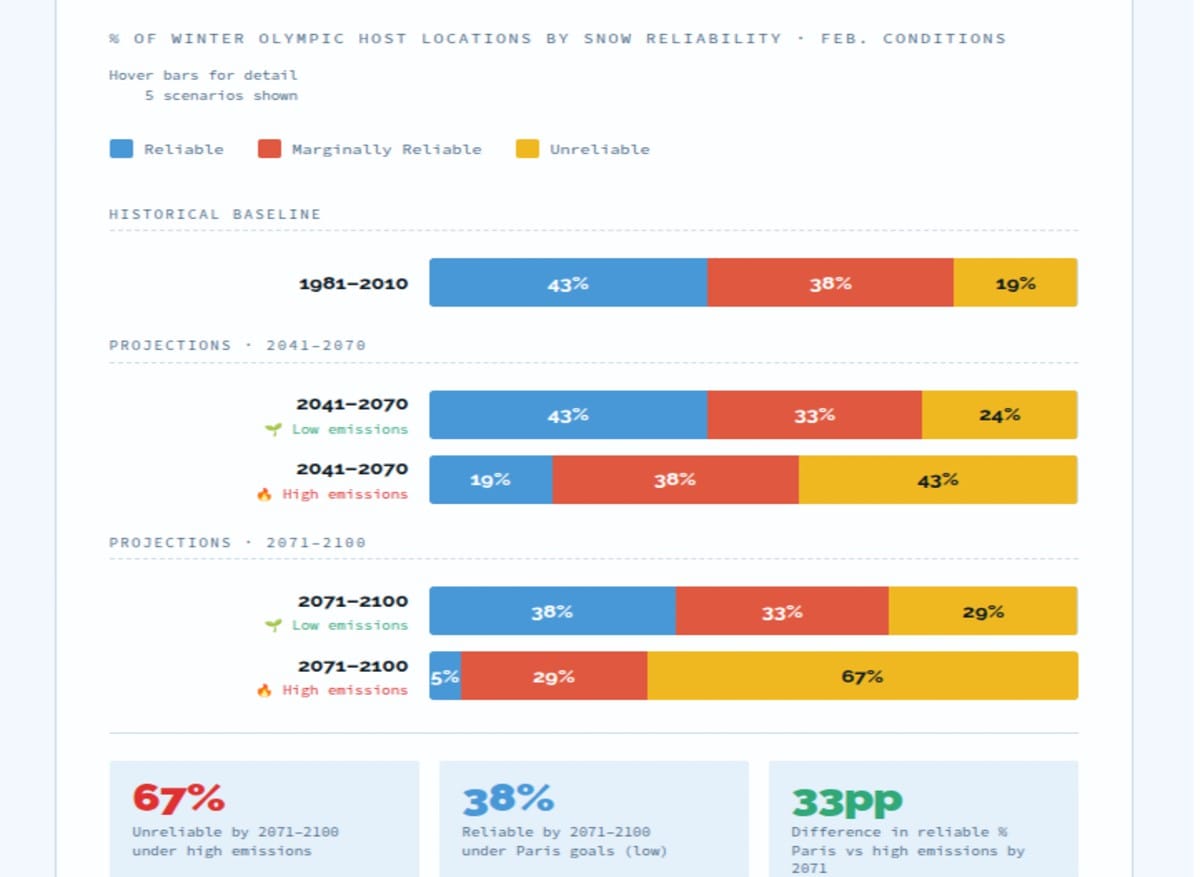
❄️ High-emissions scenario 2071–2100: Only 5% of historical Winter Olympics venues would be reliably able to host the Games under current emissions trajectories. 67% would be classified as unreliable for safe and fair competition.
% of Winter Olympic Host Locations by Snow Reliability · Feb. Conditions
Hover bars for detail
5 scenarios shown
5 scenarios shown
Reliable
Marginally Reliable
Unreliable
67%
Unreliable by 2071–2100
under high emissions
under high emissions
38%
Reliable by 2071–2100
under Paris goals (low)
under Paris goals (low)
33pp
Difference in reliable %
Paris vs high emissions by 2071
Paris vs high emissions by 2071
Source: Current Issues in Tourism (2022) · Projection methodology: Paris Agreement goals (low) vs current trajectory (high emissions) · February conditions
43%Reliable 1981–2010
Historical Baseline
Historical Baseline
5%Reliable 2071–2100
High Emissions
High Emissions
38%Reliable 2071–2100
Paris Goals Met
Paris Goals Met
67%Unreliable 2071–2100
High Emissions
High Emissions
The Specific Vulnerability of Winter Sport
The Winter Olympics is the most climatologically constrained major sporting event in the world. Unlike the Summer Games, which require only weather mild enough for outdoor sport, the Winter Games require a very specific and increasingly fragile atmospheric condition: reliably cold temperatures and adequate natural snowfall in February. The research published in Current Issues in Tourism (2022) — examining historical Winter Olympics host locations and projecting their February snow conditions forward under different emissions scenarios — reveals a situation that should be causing significant anxiety among Olympic administrators, winter sports federations, and the host cities and countries that have invested billions in winter sports infrastructure.
The baseline figure — that 43% of historical Winter Games host locations were "reliably" able to provide safe and fair snow conditions in February during the 1981-2010 reference period — is itself concerning. More than half of the places that have hosted the Winter Olympics were already marginal or unreliable for snow conditions in the recent historical period. Under the low-emissions scenario (Paris Agreement targets met), the reliable percentage stays at 43% through 2041-2070 before declining to 38% by 2071-2100. This is the optimistic scenario, and it still produces meaningful degradation by century's end.
Under the Paris Agreement trajectory, 38% of past Winter Olympic venues remain reliable by century's end. Under the current emissions trajectory, 5% do. The Winter Games' future is not primarily a sports story — it is a climate policy story.
The High-Emissions Scenario: 5% Reliable
The high-emissions scenario — which represents the current trajectory of global emissions without significant additional policy intervention beyond existing commitments — produces an extraordinary degradation of Winter Games hosting capacity. By 2041-2070, reliable locations drop from 43% to 19% while unreliable locations expand from 19% to 43%. By 2071-2100, the numbers are even starker: 5% reliable, 29% marginally reliable, and 67% unreliable.
In practical terms, what does "67% unreliable" mean for the Winter Olympics? It means that in a future world following the current emissions trajectory, only 5 of every 100 past Winter Games host sites — roughly 1 in 20 — could reliably be expected to provide the snow conditions necessary for safe and fair alpine skiing, biathlon, bobsled, and the dozens of other disciplines that require specific and consistent snow states. The IOC would face a choice between moving the Games to the small number of remaining climatically suitable locations (high-altitude venues in Scandinavia, the Alps, Japan, and perhaps some high-Andean sites), accepting artificial snow as the permanent norm, or fundamentally restructuring which sports constitute the Winter Games.
Artificial snow is already the dominant snow source at many recent Winter Olympics venues — the Beijing 2022 Winter Olympics, held in areas of China that receive very little natural snow, used almost entirely artificial snow. The energy and water costs of artificial snow production at Olympic scale are significant, and the use of artificial snow on terrain designed for high-speed alpine events creates surface conditions that are measurably different from natural snow — raising questions about competitive equity and athlete safety that the "reliable" classification is explicitly designed to capture.
Which Venues Are Already at Risk
The research does not publicly list which specific past host locations fall into each reliability category, but the general geographic pattern is inferable from what is known about alpine climate change. Lower-elevation venues in continental Europe — Garmisch-Partenkirchen (Germany), Grenoble (France), Innsbruck (Austria), Sarajevo (Yugoslavia/Bosnia) — are most vulnerable, as they sit at elevations where February temperatures are already marginal and warming trends are most acute in winter months. Mediterranean-adjacent hosts like Squaw Valley (now Palisades Tahoe, California) face warming and shifting precipitation patterns that make their long-term snow reliability increasingly uncertain.
Higher-altitude venues — Cortina d'Ampezzo (Italy), St. Moritz (Switzerland), and especially the Scandinavian hosts — are more resilient but not immune. Norway has hosted the Winter Games in Oslo (1952) and Lillehammer (1994); both are vulnerable to warming winter temperatures, with Lillehammer's relatively modest elevation making it particularly susceptible. The high-altitude venues most likely to retain reliability under high-emissions scenarios are in the Japanese Alps (Sapporo hosted in 1972, Nagano in 1998) and potentially the high-elevation Swiss and Austrian Alps, though even these face risk by late century under the worst scenarios.
The Paris Agreement as Olympic Policy
The most consequential finding in the data is the 33-percentage-point difference in reliable hosting capacity between the low-emissions (Paris Agreement) scenario and the high-emissions (current trajectory) scenario by 2071-2100. Under Paris goals, 38% of past venues remain reliable — a meaningful decline from the historical baseline, but not a civilisational disruption to winter sport. Under the current trajectory, 5% remain reliable — effectively ending the Winter Games as a geographically diverse event and concentrating it in an ever-smaller number of still-viable high-altitude locations.
This makes climate policy directly relevant to winter sports governance in a way that is rarely acknowledged in sports administration. The IOC, international skiing federations, and national Olympic committees have a direct institutional interest in emissions reduction — not as abstract environmental stewardship but as concrete protection of the conditions that make their sports viable. The Winter Games community's historically muted engagement with climate advocacy has been changing: the IOC has committed to carbon neutrality and requires host cities to meet sustainability standards, but these commitments are at the margins of what the data suggests is necessary.
The difference between a 38%-reliable and a 5%-reliable future for winter sports is made in the decisions of the next decade — on energy transition, emissions regulation, and international climate cooperation. Athletes who will compete in the 2050 or 2080 Winter Olympics are children today, and the world they will compete in depends on choices being made right now by governments, energy companies, and the broader political economy of decarbonisation.
The Himalayan Connection
The Winter Olympics' snow crisis is a high-profile, globally visible instance of a pattern that has the most severe consequences in the Himalayas and Hindu Kush-Karakoram ranges that India depends on for freshwater. The same warming trends that are degrading February snow conditions at Olympic venues in the Alps are accelerating Himalayan glacier retreat, threatening the water security of the Indus, Ganges, and Brahmaputra river systems that irrigate the agricultural heartlands of India, Pakistan, Bangladesh, Nepal, and China.
The Winter Olympics' vulnerability is, in this sense, a leading indicator of a much larger snow and ice crisis — one that affects not elite athletes but hundreds of millions of ordinary people who depend on glacial meltwater for drinking, irrigation, and energy generation. India's stake in the climate decisions that determine whether the future is a 38%-reliable or a 5%-reliable world is not primarily about sport. It is about whether the Himalayan water towers that supply the subcontinent's rivers continue to function, or whether they retreat to the point where seasonal water scarcity becomes a permanent feature of life across the region. The Winter Olympics data makes the stakes legible through sport. The actual stakes are measured in water.
End of Brief · Prism ❄️
