WHICH COUNTRY SCORES BEST AT SCIENCE?
Prism · Education & Human Capital
OECD PISA 2022 · Latest Available
SCORES BEST
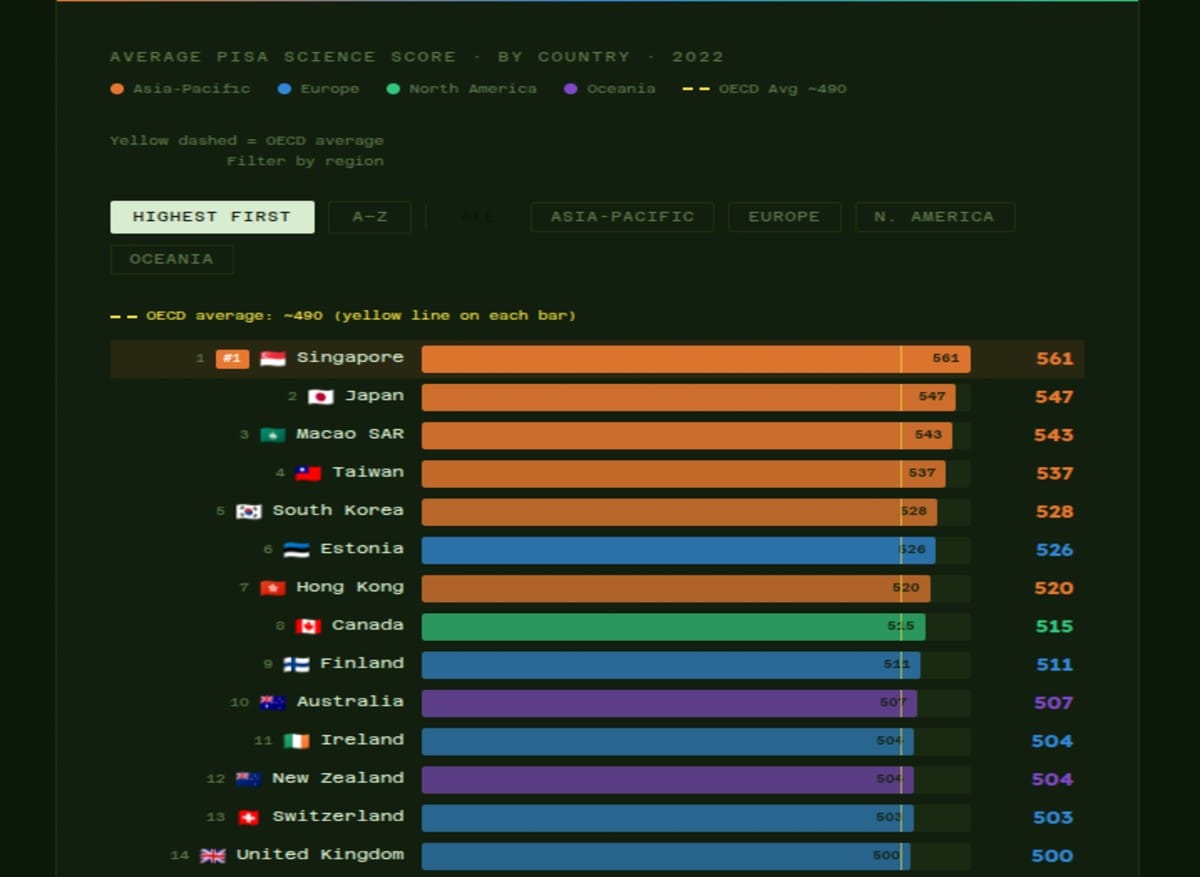
AT SCIENCE? Singapore's 15-year-olds scored 561 — 62 points above the OECD average and nearly two years of schooling ahead of the median. East Asia dominates the top of the global science table, and the gap between first and twenty-third is both a number and a policy verdict.
PISA: Programme for International Student Assessment · Measures 15-16 year-olds' real-world science reasoning
Top performers score 550–580 · OECD average: ~490 · Source: OECD · Latest data available as of 2022
Note: India does not participate in PISA (last participated 2009 · opted out of subsequent cycles)
Top performers score 550–580 · OECD average: ~490 · Source: OECD · Latest data available as of 2022
Note: India does not participate in PISA (last participated 2009 · opted out of subsequent cycles)
Average PISA Science Score · By Country · 2022
Asia-Pacific
Europe
North America
Oceania
OECD Avg ~490
Yellow dashed = OECD average
Filter by region
Filter by region
OECD average: ~490 (yellow line on each bar)
Source: OECD · Programme for International Student Assessment (PISA) 2022 · Science domain · 15-16 year olds · Latest available data
561Singapore
#1 Global
#1 Global
526Estonia
Europe #1
Europe #1
515Canada
Americas #1
Americas #1
~490OECD Average
Benchmark
Benchmark
What PISA Actually Measures
The Programme for International Student Assessment is the world's most influential education benchmarking study, conducted every three years by the OECD and covering approximately 600,000 students across 80 countries and economies. The science component specifically measures "scientific literacy" — the ability to explain phenomena scientifically, evaluate and design scientific enquiry, and interpret data and evidence scientifically — rather than curriculum-specific content knowledge. This is a consequential design choice: PISA is deliberately testing whether students can think scientifically, not whether they have memorised a particular national science curriculum.
The distinction matters because it makes PISA a measure of educational system quality rather than syllabus coverage. A country can have a very demanding national science curriculum and still score poorly on PISA if the teaching methodology emphasises rote memorisation over conceptual understanding. Conversely, countries that emphasise inquiry-based learning, critical thinking, and real-world application tend to outperform their curriculum intensity alone would predict. The East Asian countries that dominate the top of the science ranking — Singapore, Japan, Taiwan, South Korea — combine extremely high curriculum standards with teaching methodologies that develop genuine scientific reasoning ability.
Singapore's 561 is not just 62 points above the OECD average. In educational research, that gap represents approximately two full years of schooling. Singapore's 15-year-olds are performing at a level typical of 17-year-olds in median OECD countries.
Singapore at 561: The World's Most Effective Science Education
Singapore's consistent domination of international education rankings — it leads PISA in mathematics, reading, and science — is the result of a deliberate, sustained, and comprehensive national project. Singapore's Ministry of Education has operated on a philosophy of "teach less, learn more" since the 2000s — reducing curriculum content to allow deeper conceptual engagement with fewer topics. Teacher quality is exceptional: Singapore selects its teachers from the top third of each university graduating class, pays them competitively with other professions, and invests heavily in teacher development and professional learning communities.
Singapore's cultural context also matters. A small island city-state with no natural resources, Singapore has treated human capital as its primary competitive advantage since independence in 1965. Education investment has been a national priority across every government since Lee Kuan Yew's era, creating a culture where academic achievement is highly valued and parents invest significantly in educational supplementation. The combination of institutional excellence and cultural emphasis produces outcomes that are difficult to disentangle — and that other countries have found extremely difficult to replicate through institutional reform alone without the cultural substrate that supports them.
The East Asian Cluster: A Systemic Pattern
Singapore (561), Japan (547), Macao (543), Taiwan (537), South Korea (528), and Hong Kong (520) occupy six of the top seven positions in the science ranking. This concentration of East Asian education systems at the top of the global ranking has been consistent across PISA cycles since the study's inception — it is not a one-time result but a durable pattern that reflects systematic features of East Asian educational culture and institutional design.
The East Asian educational model shares several characteristics: high teacher status and selectivity, rigorous standardised assessment systems, a cultural emphasis on academic effort as a primary determinant of success (contrasted with the more ability-focused mindset in some Western education systems), extended instruction time (school years in South Korea, Japan, and Taiwan are significantly longer than in most European countries and the United States), and strong parental engagement in academic support. The private tutoring industry — known as "cram schools" (hagwon in Korea, juku in Japan, buxiban in Taiwan) — is an additional layer of academic investment that supplements formal schooling and reflects both the cultural value placed on education and the competitive pressure of high-stakes examination systems.
The East Asian model's critics note that its high outcomes on standardised assessments come with significant costs: high student stress and mental health pressures, limited time for non-academic development, and concerns about creativity and entrepreneurial thinking that may be less well-developed by highly structured educational environments. South Korea's government has repeatedly tried to reduce the intensity of the hagwon culture without success, reflecting the difficulty of changing educational behaviour when the stakes of examination performance are tied to university admissions and lifetime earnings trajectories.
Estonia at 526: Europe's Outlier
Estonia's 526 score — the highest of any European country, significantly above the UK (500), Germany (492), and France (487) — is one of the most discussed anomalies in international education research. Estonia is a small Baltic state of 1.3 million people that emerged from Soviet occupation in 1991 with a devastated economy and rebuilt its entire educational system from scratch in the 1990s. The result, three decades later, is consistently ranked among Europe's best-performing education systems.
Estonia's educational approach emphasises teacher autonomy, minimal bureaucracy, play-based early childhood education (children do not begin formal schooling until age 7), and a strong national commitment to digital literacy (the "Tiger Leap" programme digitised Estonian schools in the 1990s, and Estonia pioneered many of the digital education tools that other countries are still implementing). Estonian teachers are highly trusted professionals who are given significant curriculum flexibility. The system combines high standards with low-stakes testing environments — the antithesis of the high-stakes, exam-focused approaches common in East Asia — and produces outcomes that challenge the assumption that rigorous testing is necessary for high achievement.
India's Absence: The PISA Question
India does not appear in the PISA 2022 science rankings — not because it scored poorly, but because it does not participate in the assessment. India last participated in PISA in 2009, when the states of Himachal Pradesh and Tamil Nadu participated as a pilot. The results — which placed these states significantly below the OECD average — led India to withdraw from subsequent PISA cycles, citing concerns about the test's cultural appropriateness and the adequacy of its educational infrastructure for international comparison.
The 2009 performance, while sobering, also reflected a selective sample: Himachal Pradesh and Tamil Nadu were chosen partly because they were considered among India's better-performing states, suggesting national average performance would have been lower still. India has been in discussions with the OECD about re-engaging with PISA, with reports indicating possible participation in the 2025 cycle — though this has been discussed for several years without formal confirmation.
India's decision to remain outside PISA is itself significant data about how the Indian government perceives its educational system's readiness for international comparison. India's National Achievement Survey (NAS) and ASER (Annual Status of Education Report) provide domestic benchmarks that consistently show significant learning deficits — large proportions of students in government schools who cannot read at grade level or perform basic arithmetic. The ASER data is arguably more damning than any PISA score would be, because it measures basic literacy and numeracy rather than advanced scientific reasoning. The gap between India's educational ambitions and its current outcomes is one of the most important policy challenges facing the country, with direct implications for its ability to sustain the demographic dividend that is often cited as a structural economic advantage relative to China's ageing population.
End of Brief · Prism
