U.S. Military Budget 1997–2027P
Prism · Defense Policy & Federal Spending
U.S. Military
Budget
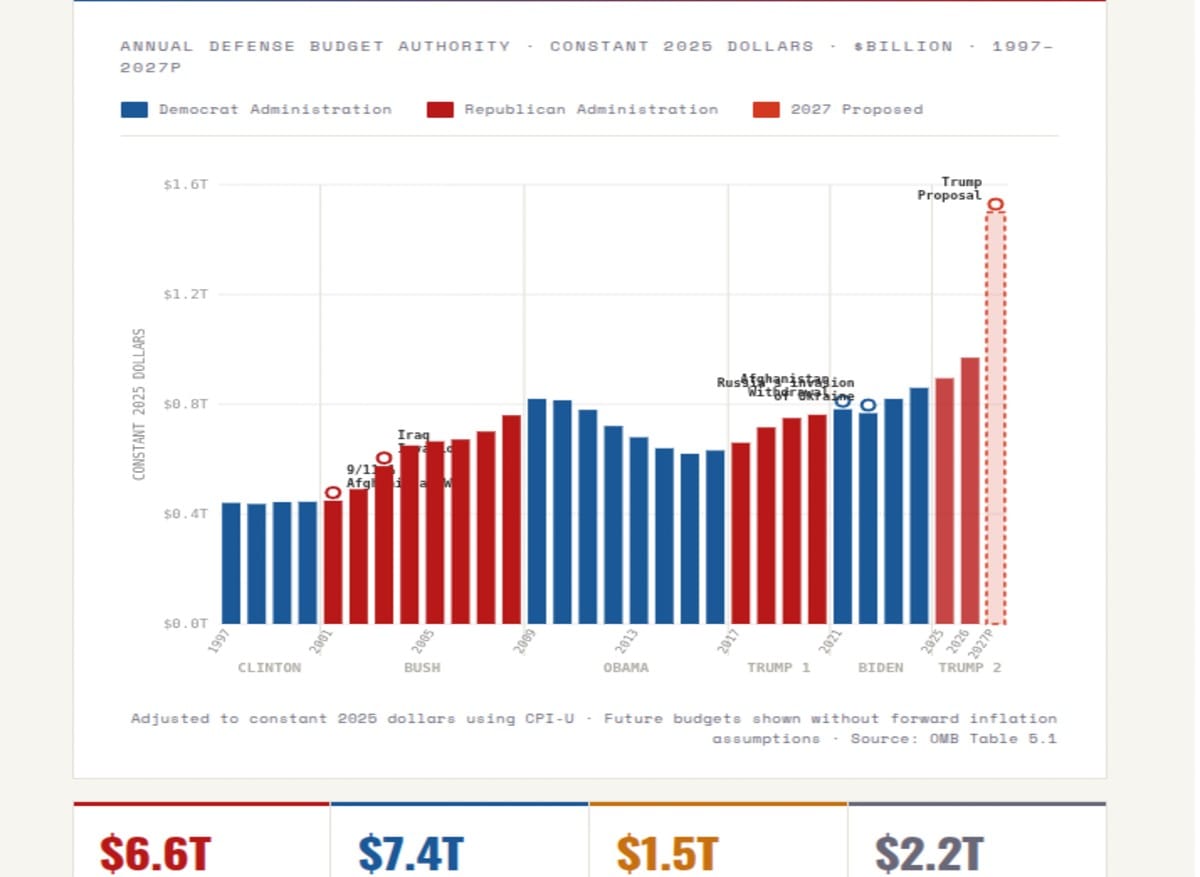
1997–2027P Three decades of U.S. defense appropriations — adjusted to constant 2025 dollars. From Clinton's post-Cold War drawdown through 9/11, Iraq, the Afghanistan surge, the Obama plateau, and Trump's proposed $1.5 trillion by 2027.
Budget
1997–2027P Three decades of U.S. defense appropriations — adjusted to constant 2025 dollars. From Clinton's post-Cold War drawdown through 9/11, Iraq, the Afghanistan surge, the Obama plateau, and Trump's proposed $1.5 trillion by 2027.
$1.5T
2027 Trump Proposal
$895B
2026 Enacted (est.)
+50%+
Proposed Increase
Annual Defense Budget Authority · Constant 2025 Dollars · $Billion · 1997–2027P
Adjusted to constant 2025 dollars using CPI-U · Future budgets shown without forward inflation assumptions · Source: OMB Table 5.1
Democrat Administration
Republican Administration
2027 Proposed
$6.6T
Bush era total
2001–2008 · Post-9/11 wars · Largest 8-year total
2001–2008 · Post-9/11 wars · Largest 8-year total
$7.4T
Obama era total
2009–2016 · Inherited war peak · Drew down to $640B
2009–2016 · Inherited war peak · Drew down to $640B
$1.5T
2027 Proposal
50%+ single-year increase · Unprecedented in peacetime
50%+ single-year increase · Unprecedented in peacetime
$2.2T
Clinton era total
1997–2000 · Post-Cold War drawdown floor
1997–2000 · Post-Cold War drawdown floor
30 Years of Spending in One Chart
The U.S. defense budget — adjusted to constant 2025 dollars — tells the story of three decades of American foreign policy through a single column of numbers. The post-Cold War drawdown under Clinton produced the lowest sustained defense spending since the Korean War era. The 9/11 attacks and the subsequent launch of operations in Afghanistan and Iraq produced the largest sustained peacetime-to-wartime budget surge in modern American history, with annual spending rising from approximately $440 billion in 2001 to a peak of approximately $820 billion in 2010 — all in constant dollars. The Bush administration's $6.6 trillion in total defense spending over eight years was the most expensive military build-up in U.S. history by any absolute measure.
The Obama administration inherited the budget at its post-9/11 peak and undertook a sustained drawdown — the Afghanistan surge of 2009–2010 briefly increased spending before the withdrawal trajectory reasserted itself, reducing annual budgets from $820 billion to approximately $620 billion by 2015. This drawdown was politically contentious and strategically contested: critics argued that reduced defense spending undermined U.S. deterrence credibility in a period of growing Chinese and Russian assertiveness. The Obama-era budget trajectory was effectively arrested by the bipartisan National Defense Authorization Acts of 2017 onward, which reversed the drawdown and began a new upward trend. The trajectory change from drawdown to expansion was one of the few areas of consistent bipartisan congressional consensus in a period of near-total partisan disagreement.
Trump's proposed $1.5 trillion defense budget for 2027 is not merely a large number — it is a proposed 50% single-year increase at a time of no declared war. The only comparable peacetime increase in modern U.S. history was Reagan's 1981–1985 build-up, which increased real defense spending by approximately 40% over four years — not in one.
The $1.5 Trillion Question
The Trump administration's proposal for $1.5 trillion in defense spending in fiscal year 2027 is the most striking figure in this dataset — not because of its absolute size, but because of its proposed speed. A 50%+ increase in a single year has no modern peacetime precedent. For comparison: the Reagan defense build-up of 1981–1985, which ended the post-Vietnam drawdown and was widely described at the time as the largest peacetime military expansion in American history, increased real defense spending by approximately 40% — over four years, not one. The proposed FY2027 increase, if enacted, would add more to the U.S. defense budget in a single year than the entire annual defense budgets of the United Kingdom, France, Germany, and Japan combined.
The stated rationale is a combination of factors: the perceived need to deter Chinese aggression in the Pacific, the lessons of Russian conventional warfare capability demonstrated in Ukraine, the modernisation of nuclear forces required by the 2018 Nuclear Posture Review, and the specific demands of Great Power competition — hypersonic missile defence, space and cyber warfare capability, and the recapitalisation of a shipbuilding industrial base that has significantly atrophied. These are legitimate strategic arguments — but they are arguments for sustained, long-term investment, not arguments for a single-year 50% budget increase. Large, rapid budget increases in the defence sector historically produce waste and acquisition failure at higher rates than sustained, gradual growth, because the defence industrial base — which requires long-term investment in skilled workers, specialised manufacturing, and supply chains — cannot scale at the rate that a sudden budget surge demands.
Party Labels and the Defense Myth
The conventional political narrative assigns defence spending generosity to Republicans and fiscal constraint to Democrats — but the historical data complicates this picture considerably. The largest single-year defense budget increase in the dataset prior to the current proposal occurred under George W. Bush — a Republican — and was driven by the response to 9/11. But Barack Obama's defence budgets, while lower on average than Bush's war-peak years, remained at historically high levels and produced the bipartisan consensus for the post-2017 build-up. Biden's defence budgets were higher in real terms than Trump's first-term budgets. The empirical record suggests that declared war and perceived strategic threat are far better predictors of defence spending than presidential party.
The one area where the partisan differential is most visible is in the explicit priority given to defence versus domestic spending. Republican administrations have consistently proposed defence increases paired with domestic discretionary cuts; Democratic administrations have generally sought to hold defence budgets while expanding domestic programmes. The result is not dramatic differences in absolute defence spending levels — which have been broadly similar across administrations adjusting for the stage of ongoing military operations — but significant differences in the compositional structure of the federal budget and in the trajectory of domestic versus military investment. The proposed $1.5 trillion for 2027 comes alongside proposed cuts to Medicaid, education, and scientific research — making the trade-off unusually explicit.
What $1.5 Trillion Buys
The question of what $1.5 trillion in annual defence spending would actually produce depends entirely on how it is allocated. The US defence budget includes personnel costs (approximately 25%), operations and maintenance (approximately 40%), procurement (approximately 20%), and research and development (approximately 13%). A rapid budget increase that goes disproportionately to procurement — buying ships, aircraft, and weapons systems — is limited by industrial capacity: the US naval shipbuilding industry in particular has contracted significantly over decades and cannot rapidly scale to produce the ships that a Pacific deterrence strategy requires, regardless of appropriated funding levels. The Congressional Budget Office has repeatedly found that appropriated shipbuilding funds have been unexecutable at planned rates due to workforce and supply chain constraints.
The most strategically efficient use of a large defence budget increase — investment in the defence industrial base, workforce training, R&D for next-generation capabilities, and allied defence cooperation — is also the slowest to produce measurable deterrence effects. The fastest uses — increased operational tempo, accelerated procurement of in-production systems, pay increases — produce immediate visible activity without necessarily building the long-term capability that Great Power competition requires. The gap between what large defence budgets are proposed to achieve and what the defence industrial and bureaucratic system can actually absorb and execute is the central challenge of American military modernisation — one that $1.5 trillion will not, by itself, resolve.
End of Brief · Prism
