
THE WORLD'S BILLIONAIRE GEOGRAPHY
Prism · Wealth & Inequality
UBS/PwC Billionaires Database · 2025
THE WORLD'S
BILLIONAIRE
GEOGRAPHY
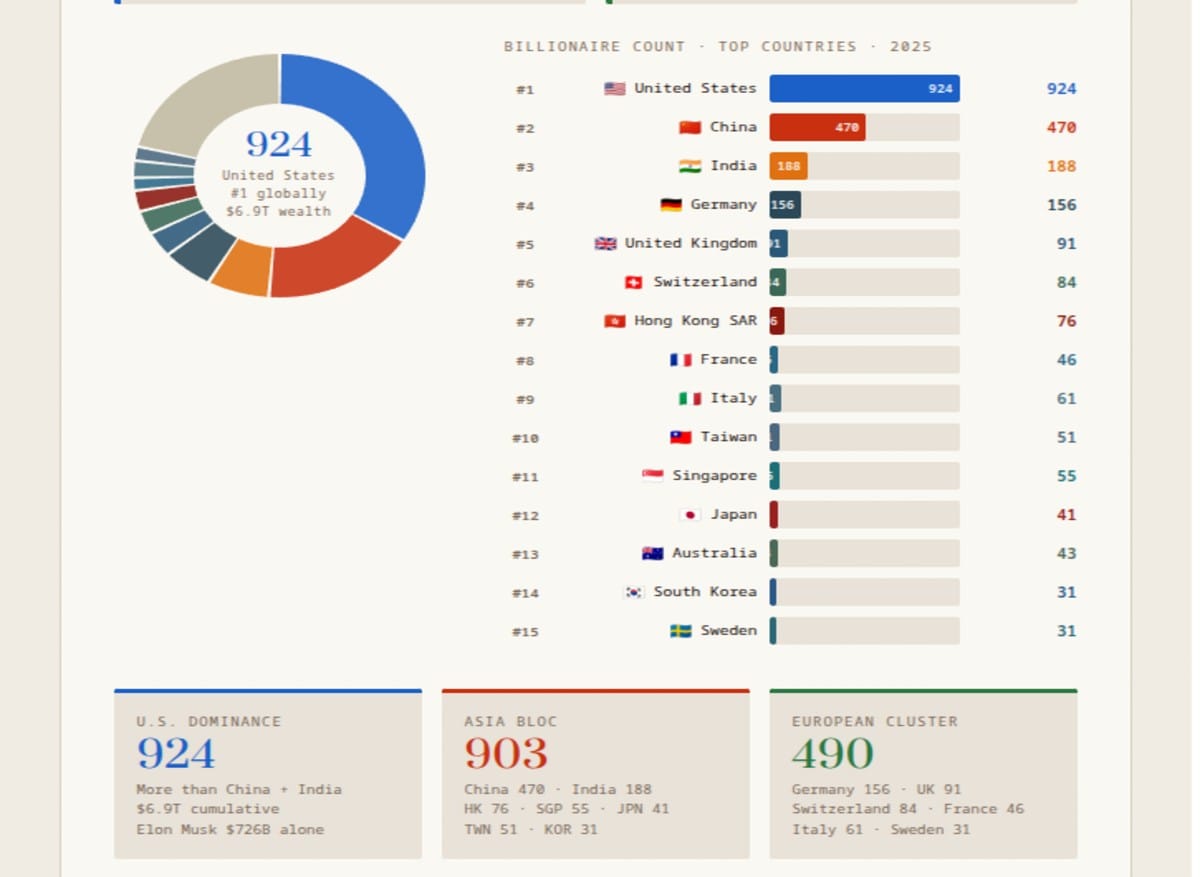
The United States has 924 billionaires — more than China (470) and India (188) combined. Their cumulative wealth is $6.9 trillion. Elon Musk alone ($726B) holds more wealth than the combined GDP of many mid-sized nations. The geography of extreme wealth is becoming simultaneously more American and more globally distributed — but the American lead, measured by count, wealth, and individual extremes, remains dominant.
Metric: Number of billionaires by country · 2025 · cumulative wealth in USD
Top 3: U.S. 924 ($6.9T) · China 470 ($1.8T) · India 188 ($888B)
Richest: Elon Musk (U.S.) $726B · Zhong Shanshan (China) $69.4B
Source: UBS/PwC Billionaires database · 47 markets tracked · Some countries excluded
Top 3: U.S. 924 ($6.9T) · China 470 ($1.8T) · India 188 ($888B)
Richest: Elon Musk (U.S.) $726B · Zhong Shanshan (China) $69.4B
Source: UBS/PwC Billionaires database · 47 markets tracked · Some countries excluded
Prism Desk·Source: UBS/PwC Billionaires Database·2025
Number of Billionaires by Country · 2025 · UBS/PwC
Hover cards & bars for detail
Source: UBS/PwC
Source: UBS/PwC
#1 · Most Billionaires
🇺🇸
United States
924
$6.9T cumulative wealth
Richest: Elon Musk $726B
Richest: Elon Musk $726B
#2 · Second Most
🇨🇳
China
470
$1.8T cumulative wealth
Richest: Zhong Shanshan $69.4B
Richest: Zhong Shanshan $69.4B
#3 · Fastest Growing
🇮🇳
India
188
$888B cumulative wealth
Among fastest-growing lists
Among fastest-growing lists
U.S.: Quality AND Quantity
924 billionaires with $6.9T wealth = avg $7.5B each. China's 470 have $1.8T = avg $3.8B. American billionaires are nearly twice as wealthy per capita as Chinese. Elon Musk ($726B) alone accounts for ~10.5% of total U.S. billionaire wealth.
Europe: Dispersed Wealth
Germany 156 ($692B) · UK 91 ($456B) · Switzerland 84 ($518B) · France 46 ($509B). Switzerland has fewer billionaires than Germany but higher per-billionaire wealth (~$6.2B avg). European billionaires concentrate in finance and pharmaceuticals.
924United States
#1 globally
$6.9T wealth
#1 globally
$6.9T wealth
U.S. Dominance924More than China + India
$6.9T cumulative
Elon Musk $726B alone
$6.9T cumulative
Elon Musk $726B alone
Asia Bloc903China 470 · India 188
HK 76 · SGP 55 · JPN 41
TWN 51 · KOR 31
HK 76 · SGP 55 · JPN 41
TWN 51 · KOR 31
European Cluster490Germany 156 · UK 91
Switzerland 84 · France 46
Italy 61 · Sweden 31
Switzerland 84 · France 46
Italy 61 · Sweden 31
The Musk effect: Elon Musk's $726B net worth represents approximately 10.5% of all U.S. billionaire cumulative wealth. If Musk were a country, he would rank #12 globally by billionaire wealth among the nations tracked. SpaceX's private valuation has been estimated as high as $800B in secondary markets, and a 2026 IPO could push Musk's net worth above $1 trillion — making him the first confirmed dollar-trillionaire.
Source: UBS/PwC Billionaires database and wealth assessment methodology · 47 markets tracked · Some countries excluded · Figures rounded
924U.S. Billionaires
#1 by Count
#1 by Count
470China
#2 by Count
#2 by Count
$6.9TU.S. Cumulative
Billionaire Wealth
Billionaire Wealth
$726BElon Musk
World's Richest
World's Richest
924 vs. The World
The United States' 924 billionaires — 37% more than China's 470 and nearly five times India's 188 — represent the most concentrated national accumulation of extreme private wealth in human history. The $6.9 trillion in cumulative billionaire wealth held by American individuals exceeds the entire GDP of every country in the world except the United States and China themselves. It exceeds the combined GDP of Germany, Japan, and the United Kingdom. It is a number whose scale is difficult to contextualise without repeated reference to comparators that are themselves extraordinary.
The United States' billionaire lead reflects several structural features of the American economy that have compounded over decades: the largest domestic capital market in the world, which has provided the liquidity infrastructure for equity-based wealth accumulation at a scale no other country can match; the world's most developed venture capital ecosystem, which has systematically converted technological innovation into equity stakes that create billionaires at a pace that European or Asian equivalents do not; and the specific dynamics of the technology sector, which has concentrated enormous market capitalisation in a small number of companies whose founders and early investors hold large equity positions. The combination of large market, efficient VC, and technology concentration is the billionaire-creation machine, and the United States has all three at maximum intensity.
924 American billionaires. $6.9 trillion in cumulative wealth. More than the GDP of every country except China and the U.S. itself. The scale is not an accident of geography — it is the product of decades of capital market development, technology sector concentration, and equity-based compensation norms that are specific to the American economic model.
China at 470: The Regulatory Reckoning
China's 470 billionaires — down from a recent peak that had China approaching U.S. numbers — reflect the trajectory of a billionaire class that was created rapidly through market-economy reforms beginning in the 1980s and then subjected to explicit regulatory constraint beginning approximately in 2020-2021. The government's campaign against the technology sector (which produced the sudden regulatory crackdown on Alibaba, Didi, Meituan, and other platforms), the private tutoring ban, and the broader "common prosperity" agenda that targeted the visibility and autonomy of private wealth created both actual and reported wealth declines for China's billionaire cohort.
Zhong Shanshan's story as China's richest individual ($69.4 billion) is instructive: a child of the Cultural Revolution who left school, worked in construction, journalism, and sales before founding Nongfu Spring — China's dominant bottled water brand — and a pharmaceutical company. His wealth, built in consumer staples rather than technology, reflects a different billionaire model than Jack Ma or Ren Zhengfei — less exposed to platform regulation, more embedded in the basic consumption economy that the Chinese government wishes to nurture. The billionaire most likely to survive China's "common prosperity" era is the one whose wealth comes from making affordable products that ordinary consumers need, rather than from platforms that intermediate large shares of economic activity.
India at 188: The Next Wave
India's 188 billionaires — with $888 billion in cumulative wealth — represent the third largest national cohort, and by most analyses the one with the strongest growth trajectory. India's economy is growing at 6-7% annually, its technology sector is expanding, its capital markets are among the most active in Asia, and the demographic dividend of a young and increasingly educated population is beginning to generate the entrepreneurial activity that creates new wealth at scale. The Indian billionaire class has historically been dominated by a small number of industrial conglomerate families — the Ambanis, the Tatas, the Birlas, the Adanis — but is now diversifying into technology, financial services, and consumer brands.
The concentration of Indian billionaire wealth is notable: the top 10 Indian billionaires hold a disproportionate share of the total $888 billion, reflecting the highly concentrated nature of Indian corporate ownership where founding families maintain extraordinary control through cross-holding structures and voting arrangements. Mukesh Ambani's Reliance Industries controls assets spanning energy, telecommunications, retail, and media in ways that have no close American equivalent in terms of a single individual's control over a diversified economic empire. The Indian billionaire cohort's growth over the next decade will be closely watched as a leading indicator of whether India's economic development follows the capital-intensive conglomerate model of the 20th century or the startup-to-scale technology model that characterised American billionaire creation in the 21st.
Europe's Billionaire Geography: Switzerland Over Germany
Germany's 156 billionaires — the most in Europe by count — contrast with Switzerland's 84 who hold $518 billion in wealth, compared to Germany's $692 billion for nearly twice the number. The Swiss per-billionaire wealth (~$6.2 billion average) substantially exceeds Germany's (~$4.4 billion average), reflecting the specific concentration of Swiss billionaire wealth in pharmaceuticals, financial services, and luxury goods — sectors with extraordinary profit margins and global market positions. The Bertarelli family (Serono pharmaceuticals), the Kamprad family (IKEA, Swedish but Swiss-resident), and multiple pharmaceutical billionaires from Roche, Novartis, and other companies anchor Swiss wealth at high per-person levels.
France's 46 billionaires holding $509 billion — an average of $11.1 billion per billionaire — reflects the extraordinary concentration of French billionaire wealth in Bernard Arnault and the LVMH luxury goods empire, which at its peak made Arnault the world's richest person. French billionaire wealth, even more than Swiss, is concentrated in a handful of extraordinary fortunes rather than distributed across a larger number of moderately wealthy individuals. The French billionaire list is essentially a luxury goods company ownership list, with the pharmaceutical and energy sectors adding secondary entries.
Singapore at 55 and Hong Kong at 76: The Hub Premium
Singapore's 55 billionaires and Hong Kong's 76 — both extraordinary concentrations for their population sizes — reflect the specific billionaire-attracting properties of low-tax, high-rule-of-law financial centres that provide the legal and fiscal infrastructure for wealth preservation at a scale that larger countries with higher tax rates cannot match. Hong Kong and Singapore have both seen significant inflows of wealth from mainland China following the political and regulatory uncertainties of the 2020-2022 period, as wealthy Chinese families relocated assets and sometimes residency to jurisdictions with more predictable legal environments.
The per-capita billionaire density of Singapore (approximately 9 billionaires per million people) and Hong Kong (approximately 10 per million) dwarf any large country in the world and reflect the specific economic function these cities serve in global wealth management. A Singaporean billionaire may have built their wealth in China, Indonesia, or the Philippines and chosen Singapore as their legal domicile for reasons entirely unrelated to Singapore's domestic economy — making the Singapore billionaire count less a measure of Singaporean wealth creation than of the city-state's attractiveness as a domicile for wealth created elsewhere. The same applies to Hong Kong, where the $328 billion in cumulative billionaire wealth significantly reflects mainland Chinese assets held through Hong Kong structures rather than wealth generated by economic activity within Hong Kong's borders.
Elon Musk and the Geometry of Extreme Wealth
Elon Musk's $726 billion net worth — the highest of any individual tracked in the UBS/PwC database — demands specific analysis because it is not simply a large number in the same category as other billionaire fortunes. It is approximately 10× the fortune of the world's next 10 wealthiest individuals combined with a multiple, and it occupies a statistical position in the distribution of global wealth that has no recent historical precedent. The $726 billion figure is primarily driven by equity stakes in SpaceX (estimated market cap $150-250B depending on the methodology), Tesla (public company; Musk holds approximately 13% of shares outstanding), and xAI (private AI company valued at approximately $50B in recent rounds).
The SpaceX valuation uncertainty is the largest source of noise in Musk's reported net worth. Secondary market transactions in SpaceX shares have implied valuations as high as $800 billion, making it potentially the most valuable private company in history; but SpaceX has not gone public, and private company valuations are inherently more uncertain than public market marks. A SpaceX IPO — which Musk has discussed but not committed to — would likely be the largest initial public offering in American history and could produce a net worth figure for Musk that crosses the trillion-dollar threshold. The question of whether Musk becomes the world's first confirmed dollar-trillionaire is, at this point, primarily a question about SpaceX's IPO timing and valuation, not about the underlying economics of the business.
End of Brief · Prism