
SCARS ON THE EARTH FOREVER
Prism · Earth Science
Earth Impact Database · Wikipedia · 2025
SCARS ON
THE EARTH
FOREVER
Chicxulub ended the age of dinosaurs. Vredefort is 2.02 billion years old and still the largest confirmed impact structure on Earth. Popigai's impact diamonds are found nowhere else. The 12 biggest craters in Earth's history represent not just geological curiosities but the most violent events in our planet's biography — several of them correlated with mass extinctions that reset the trajectory of life on Earth.
Metric: Diameter of confirmed impact craters (rim-to-rim · current collapsed dimension · not original impact diameter)
Largest: Vredefort 160km (South Africa · 2.02 BYA) · Chicxulub 150km (Mexico · 65 MYA · K-Pg extinction)
Most recent: Popigai 90km (Russia · 36 MYA) · mass-extinction linked
Sources: Earth Impact Database · Wikipedia · Google Maps
Largest: Vredefort 160km (South Africa · 2.02 BYA) · Chicxulub 150km (Mexico · 65 MYA · K-Pg extinction)
Most recent: Popigai 90km (Russia · 36 MYA) · mass-extinction linked
Sources: Earth Impact Database · Wikipedia · Google Maps
Prism Desk·Sources: Earth Impact Database · Wikipedia
Earth's 12 Biggest Confirmed Impact Craters · Diameter · Age
Hover craters for detail
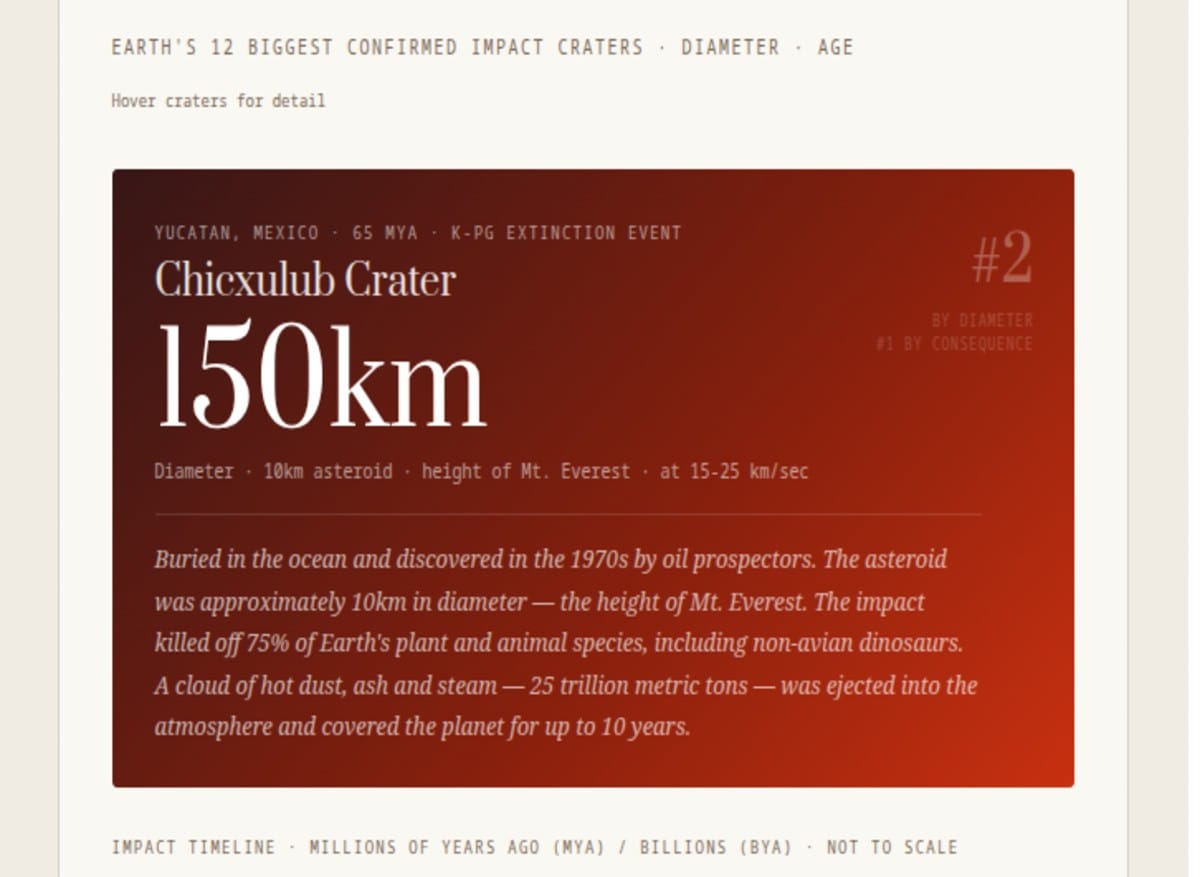
#2By diameter
#1 by consequence
Yucatan, Mexico · 65 MYA · K-Pg Extinction Event
Chicxulub Crater
150km
Diameter · 10km asteroid · height of Mt. Everest · at 15-25 km/sec
Buried in the ocean and discovered in the 1970s by oil prospectors. The asteroid was approximately 10km in diameter — the height of Mt. Everest. The impact killed off 75% of Earth's plant and animal species, including non-avian dinosaurs. A cloud of hot dust, ash and steam — 25 trillion metric tons — was ejected into the atmosphere and covered the planet for up to 10 years.
#1 by consequence
Impact timeline · millions of years ago (MYA) / billions (BYA) · not to scale
TODAY
Crater diameter comparison · proportional circles · km
| Crater | Location | Diameter | Age | Notable |
|---|
Mass Extinction Linked3 cratersChicxulub (K-Pg, 75% species)
Siljan (Devonian extinction?)
Popigai (Eocene-Oligocene)
Siljan (Devonian extinction?)
Popigai (Eocene-Oligocene)
Now Submerged / Buried4 cratersChicxulub (ocean + sediment)
Charlevoix (partial St.Lawrence)
Kara (surface eroded)
Tookoonooka (deep below rock)
Charlevoix (partial St.Lawrence)
Kara (surface eroded)
Tookoonooka (deep below rock)
Economic Significance3 cratersSudbury (Ni/Cu mining)
Popigai (impact diamonds)
Tookoonooka (petroleum drilling)
Popigai (impact diamonds)
Tookoonooka (petroleum drilling)
Scale note: Diameters measured are the current rim-to-rim dimensions of the collapsed, transient crater — not the original impact damage diameter, which would have been substantially larger for most craters. Vredefort's original impact damage zone was estimated at 300km; Chicxulub's at 240km. Billions of years of erosion, tectonics, sedimentation, and volcanic activity have reduced or obscured most ancient craters. Many large impacts almost certainly remain undiscovered beneath ocean sediments or deep geological sequences.
Sources: Earth Impact Database · Wikipedia · Google Maps · Diameter is best estimate for current collapsed crater (rim-to-rim dimension)
160kmVredefort
Largest Crater
Largest Crater
2.02 BYAVredefort Age
Oldest Confirmed
Oldest Confirmed
65 MYAChicxulub
K-Pg Extinction
K-Pg Extinction
36 MYAPopigai
Most Recent Top 12
Most Recent Top 12
When Rocks Fall from the Sky
The Earth Impact Database lists over 190 confirmed impact structures on Earth's surface — geological scars left by asteroids and comets that collided with our planet over its 4.5-billion-year history. The 12 largest, ranging from 36km (Siljan Ring, Sweden) to 160km (Vredefort, South Africa), represent the most violent events in Earth's geological biography: collisions with objects travelling at 15-25 kilometres per second that released energies measured in the trillions of megatons of TNT, fundamentally reshaping regional geology and, in at least one confirmed case and possibly two others, triggering mass extinctions that reset the trajectory of life on the planet.
The confirmed impact crater count of 190+ is almost certainly a dramatic undercount of the total impacts Earth has experienced. The planet's geological activity — plate tectonics, volcanism, erosion, sedimentation, and the coverage of 71% of its surface by ocean — has erased or concealed the vast majority of impact structures from the geological record. The Moon, which lacks the geological processes that destroy impact records, provides an upper bound estimate: the lunar surface shows evidence of hundreds of thousands of impact craters, suggesting that Earth — a larger target in the inner solar system — has been struck many thousands of times. The visible record is a small and geologically biased sample of the full bombardment history.
The 190 confirmed impact craters on Earth are almost certainly a dramatic undercount. The Moon — too small and geologically inactive to erase its record — shows hundreds of thousands of craters. Earth has been struck many thousands of times. Most of the evidence is simply gone.
Vredefort at 160km: The Oldest Scar
The Vredefort Dome in South Africa — at 160km the largest confirmed impact structure on Earth — was created approximately 2.02 billion years ago, making it the second oldest confirmed impact structure in the database after Yarrabubba in Australia (2.23 billion years). The impacting asteroid is estimated to have been 10-15km in diameter, colliding at 15-25 km/second and releasing energy estimated at 5,200,000 megatons of TNT. The impact is estimated by some researchers to have significantly altered Earth's atmosphere and climate, though the 2-billion-year time gap makes direct biological consequence extremely difficult to establish — the dominant life forms at the time were single-celled organisms whose fossil record is sparse.
The current 160km measurement reflects the significantly eroded and compressed remnant of what researchers estimate was originally a 300km impact damage zone. Vredefort is now a UNESCO World Heritage Site, the dome structure representing a geological cross-section through the Earth's crust that has been invaluable for understanding deep crustal composition. The surrounding region is also one of the world's richest gold and uranium mining areas — a coincidence of geological chemistry that was enhanced by the impact event itself. The Vredefort impact may have contributed to concentrating gold-bearing fluids in the Witwatersrand basin that has produced over 50% of all the gold ever mined in human history.
Chicxulub at 150km: The Dinosaur Killer
The Chicxulub crater — buried beneath the Yucatan Peninsula and the Gulf of Mexico, discovered only in the late 1970s when oil prospectors noted anomalous seismic and gravity data — is both the second largest confirmed impact structure and the most consequential event in recent Earth history. The approximately 10km asteroid (approximately the height of Mount Everest) that created it impacted at 65 million years ago, at precisely the boundary between the Cretaceous and Paleogene geological periods — the K-Pg boundary — that marks one of the five largest mass extinction events in Earth's history.
The mass extinction that followed the Chicxulub impact killed approximately 75% of all plant and animal species on Earth, including all non-avian dinosaurs — effectively terminating the 165-million-year reign of the dinosaurs that had dominated terrestrial ecosystems since the Triassic period. The mechanism has been extensively studied: the immediate blast effect, the magnitude 11+ seismic activity, the tsunami, and most importantly the atmospheric injection of 25 trillion metric tons of hot dust, ash, and steam that blocked sunlight for years to decades, collapsing photosynthesis-dependent food chains globally. The survivors — small, burrowing, omnivorous mammals — occupied the ecological vacancies left by the dinosaurs' extinction, and the subsequent diversification of mammals over the following 65 million years produced the current dominant vertebrate fauna of Earth, including the hominid lineage that ultimately produced modern humans.
Without Chicxulub, there is no mammalian diversification. Without mammalian diversification, there are no primates. Without primates, no hominids. Without hominids, no humans. The 10km asteroid that struck the Yucatan 65 million years ago is, in the deepest sense, a prerequisite for human existence.
Sudbury at 130km: When Catastrophe Becomes Industry
The Sudbury Basin in Ontario, Canada — 130km in diameter, 1.85 billion years old — is one of the most economically valuable geological structures in the world. The Sudbury Basin contains one of the largest nickel and copper ore deposits on Earth, and the city of Sudbury has been one of the world's most important mining communities for over a century. The connection between the impact and the ore deposits reflects a specific geochemical process: the meteorite impact melted and fractured the deep crustal rocks of the Canadian Shield, allowing nickel and copper-rich magmatic fluids to intrude into the fractured zone and concentrate into ore bodies that would not have formed under normal geological conditions.
The Sudbury structure also provided some of the earliest evidence that resolved a historical controversy about its origin: early geologists believed the anomalous circular structure was a volcanic caldera, but detailed analysis of the rock types — including shatter cones, shocked quartz, and impact melt rocks — definitively established its meteorite impact origin. The lesson was significant for planetary geology: many structures initially interpreted as volcanic or tectonic in origin have subsequently been reanalysed as impact structures as the diagnostic criteria for identifying impact events have become better established. The Sudbury discovery contributed to the development of impact geology as a distinct scientific discipline.
Siljan Ring at 36km: The Mass Extinction Connection
The Siljan Ring in Dalarna, Sweden — at 36km the smallest of the top 12 but potentially the most geologically consequential of the European impacts — is dated to approximately 377 million years ago, placing it within the Late Devonian period at a time associated with one of the five largest mass extinctions in Earth's history, the Late Devonian extinction. This extinction event killed approximately 75% of all species on Earth, with marine organisms — particularly reef-building organisms — suffering catastrophic losses.
The proposed connection between the Siljan impact and the Late Devonian extinction is scientifically contested. The timing is consistent, but impact researchers debate whether a 36km crater (from an asteroid perhaps 2km in diameter) would generate sufficient atmospheric and ecological disruption to trigger a global mass extinction event. The current scientific consensus is that the Devonian extinction was more likely caused by climate change associated with the rapid spread of land plants, which radically altered weathering rates, buried organic carbon, reduced atmospheric CO2, and cooled Earth's climate — with the Siljan impact possibly playing a supplementary role or simply coinciding with an extinction that was already under way. The causal attribution of mass extinctions to specific impact events is one of the most contested areas in Earth science, requiring the coincidence of impact timing, extinction timing, and mechanism to be established simultaneously.
Popigai at 90km: The Impact Diamond Factory
The Popigai crater in Siberia — 90km in diameter, approximately 36 million years old — is notable for two reasons: it is the most recent of the 12 largest craters, and it is the world's largest known deposit of a specific type of diamond created by impact metamorphism. When the Popigai impactor struck a graphite-bearing rock formation at hypersonic velocity, the instantaneous pressure and temperature conditions converted the graphite directly into diamond — the same carbon chemistry, compressed in nanoseconds rather than over geological time periods. These "impact diamonds" or lonsdaleite crystals are found nowhere else on Earth in comparable concentrations and have potential industrial applications as abrasives and cutting materials.
Popigai's 36 million year age places it at the Eocene-Oligocene boundary, which is associated with a global cooling event and a significant faunal turnover — and is temporally close to another large impact, Chesapeake Bay (in Virginia, approximately 35 million years ago). Whether these two impacts, occurring within approximately 1 million years of each other, contributed to the Eocene-Oligocene boundary cooling event or were coincidental with it is an active research question. The possibility of impact-triggered climate perturbations cascading across geological time scales is one of the more active frontiers in impact geology and climate science, with implications for understanding Earth's climate sensitivity to large perturbation events.
End of Brief · Prism