NUCLEAR WEAPONS BY COUNTRY
Prism · Defence & Geopolitics
Federation of American Scientists · June 2025
WEAPONS
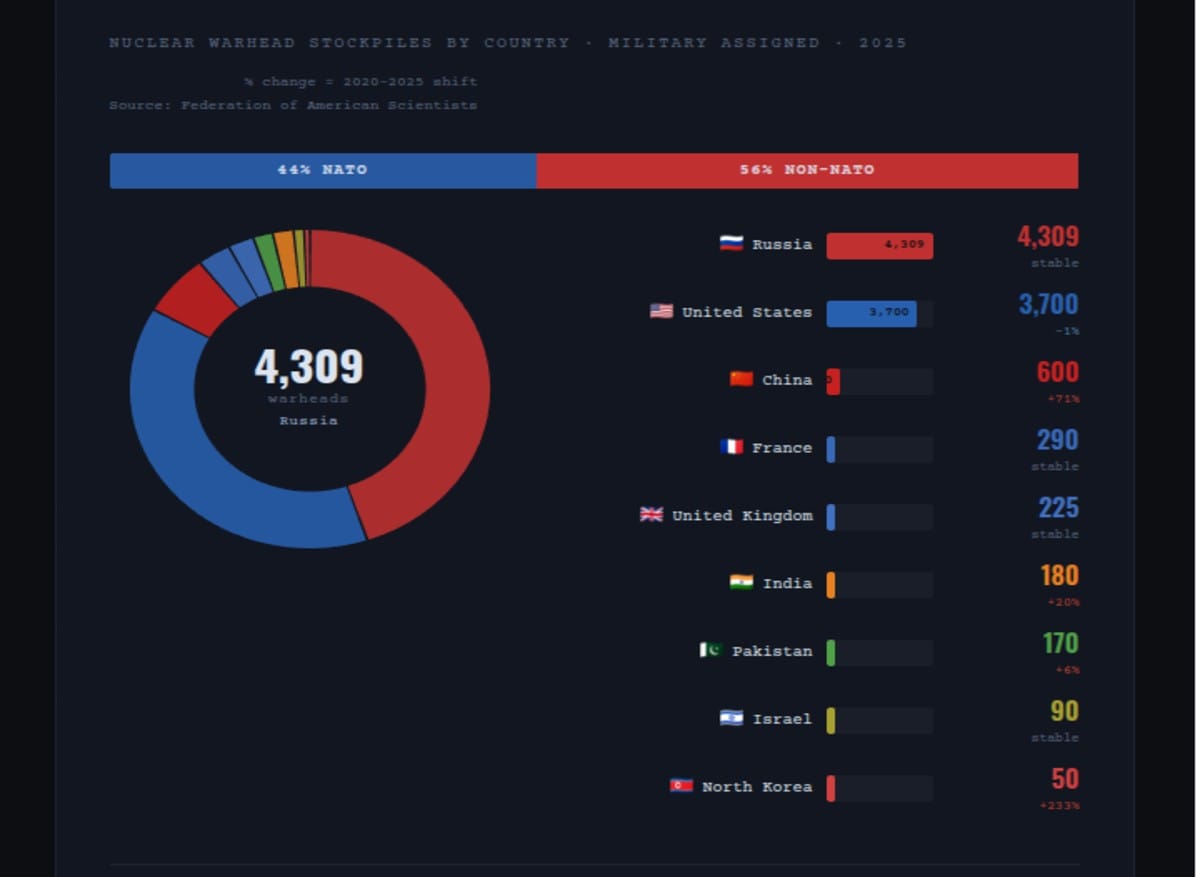
BY COUNTRY Russia holds 4,309 warheads assigned to military forces. China has grown its stockpile by 71% since 2020. And the treaty framework that constrained these arsenals for fifty years has lapsed. The nuclear order is changing faster than public debate recognises.
Stockpile definition: Warheads assigned to military forces — excludes retired warheads awaiting dismantlement
Data as of June 12, 2025 · Source: Federation of American Scientists
New START expiration: The U.S.–Russia nuclear treaty lapsed in 2026, removing warhead limits for the first time in 50 years
Data as of June 12, 2025 · Source: Federation of American Scientists
New START expiration: The U.S.–Russia nuclear treaty lapsed in 2026, removing warhead limits for the first time in 50 years
⚠️ Treaty context: The expiration of the U.S.–Russia New START treaty in 2026 removed the only remaining legal limit on strategic nuclear arsenals. No replacement framework is under active negotiation. China has never been party to a bilateral arms control treaty limiting its nuclear forces.
Nuclear Warhead Stockpiles by Country · Military Assigned · 2025
% change = 2020–2025 shift
Source: Federation of American Scientists
Source: Federation of American Scientists
4,309
warheads
Russia
Largest Stockpile Changes · 2020–2025
🇰🇵 North Korea
+233%
15→50 warheads · Fastest growth by % · Active ICBM testing
🇨🇳 China
+71%
350→600 warheads · Projected 1,000+ by 2030 per DoD
🇮🇳 India
+20%
150→180 warheads · Triad modernisation ongoing
🇵🇰 Pakistan
+6%
160→170 warheads · Largest arsenal in South Asia by estimate
🇷🇺 Russia · 🇫🇷 France · 🇬🇧 UK · 🇮🇱 Israel
0%
Stable stockpiles 2020–2025 · US: −1%
🌐 Treaty Status
NEW START
LAPSED 2026 expiry · No replacement · First unconstrained period since 1972
LAPSED 2026 expiry · No replacement · First unconstrained period since 1972
Source: Federation of American Scientists · Stockpiles = warheads assigned to military forces · Data June 2025
4,309Russia
Largest Arsenal
Largest Arsenal
3,700United States
#2 Stockpile
#2 Stockpile
600→1,000+China · Now vs
Projected 2030
Projected 2030
+233%N. Korea Growth
2020–2025
2020–2025
The Treaty-Free Nuclear World
The expiration of the New START treaty in February 2026 was the single most consequential development in nuclear arms control since the Intermediate-Range Nuclear Forces (INF) Treaty's collapse in 2019. New START — formally the Treaty Between the United States of America and the Russian Federation on Measures for the Further Reduction and Limitation of Strategic Offensive Arms — capped each side's deployed strategic warheads at 1,550 and their deployed delivery systems at 700. Its lapse means that for the first time since the Strategic Arms Limitation Talks began in 1972, the world's two largest nuclear arsenals face no legally binding mutual constraints.
Russia suspended its participation in New START verification in 2023, citing American support for Ukraine, and formally declined to renew the treaty. The United States, while expressing willingness to negotiate a successor agreement, has not found a pathway to resume talks. The result is an arms control vacuum that both sides have so far managed without dramatic escalation in stockpile numbers — Russia's 4,309 and the United States' 3,700 reflect continued informal restraint — but the absence of a verification framework means that restraint is now an act of unilateral policy rather than treaty obligation. The difference between those two is significant: treaty obligations create monitoring, verification, and diplomatic costs for violation; policy restraint can be reversed without notice.
For the first time in fifty years, there is no treaty limiting Russia's and America's strategic nuclear arsenals. The absence of a framework is not merely a diplomatic gap — it is a structural change in how nuclear risk is managed.
Russia's 4,309: Stability with Ukraine Backdrop
Russia's 4,309 military-assigned warheads represent the world's largest nuclear stockpile, a position Russia has held consistently since the Soviet Union's dissolution. The 0% change figure in the 2020-2025 period reflects a degree of doctrinal stability even as Russia has dramatically raised the rhetorical salience of nuclear weapons in the context of its war against Ukraine. Russian official statements, doctrine documents, and military exercises have repeatedly invoked nuclear capability in ways that Western analysts consider deliberate coercive signalling — communicating that nuclear escalation is a credible risk in order to constrain Western support for Ukraine.
The gap between Russia's nuclear rhetoric and its actual stockpile behaviour — unchanged despite the most significant European land war since 1945 — suggests that the signalling is primarily strategic communication rather than genuine escalation preparation. However, this interpretation carries its own risks: the pattern of rhetoric without action can create a "crying wolf" dynamic in which genuine escalatory intent might be discounted by Western decision-makers who have grown accustomed to Russian nuclear signalling without follow-through.
China's 71% Growth: The Strategic Wildcard
China's 71% growth in military-assigned warheads since 2020 — from approximately 350 to 600 — is the most consequential development in the global nuclear balance for decades. The US Department of Defense projects China's stockpile will exceed 1,000 warheads by 2030, a pace of expansion without precedent among established nuclear powers in the post-Cold War period. China is simultaneously modernising all three legs of its nuclear triad (land-based ICBMs, submarine-launched ballistic missiles, and air-delivered weapons), constructing new silo fields in remote regions, and reportedly moving toward a launch-on-warning posture that represents a significant departure from its historical "minimum deterrence" doctrine.
China has never participated in a bilateral arms control framework. During both the Obama and Trump administrations, the United States proposed including China in trilateral arms control negotiations with Russia; China declined, arguing that its much smaller stockpile made trilateral talks inequitable until China reached numerical parity with the US and Russia. The expansion since 2020 raises the question of what happens as China approaches that parity — whether it will then be willing to negotiate, or whether the expansion itself reflects a changed strategic ambition that makes arms control less attractive.
China's nuclear expansion is directly relevant to India's security calculus in ways that go beyond the conventional military balance. China's growing second-strike capability — the ability to absorb a nuclear first strike and still retaliate — changes the strategic environment that India must plan around. India maintains a no-first-use (NFU) doctrine for its nuclear forces; China nominally does as well, though analysts increasingly question whether China's modernisation is compatible with a genuine NFU posture. If China's NFU commitment erodes under conditions of nuclear expansion, India's strategic calculations across the Himalayan border will need to adjust accordingly.
India's 180: The Credible Minimum and Its Tensions
India's 180 warheads — a 20% increase from 2020 — reflect a continued commitment to what India's doctrine describes as "credible minimum deterrence": a stockpile sufficient to guarantee assured retaliation but sized to signal defensive intent rather than offensive capability. India's nuclear triad is in the process of maturation: the Agni-V intercontinental ballistic missile provides continental range; the Arihant-class nuclear-powered ballistic missile submarines are operational, providing a survivable second-strike capability; and air-delivered nuclear capability exists through modified aircraft.
India faces a unique strategic challenge that no other nuclear power confronts in quite the same form: simultaneous deterrence requirements against two nuclear-armed neighbours — China and Pakistan — with fundamentally different deterrence relationships. The China deterrent requires long-range delivery systems capable of reaching Chinese cities and military installations from survivable platforms. The Pakistan deterrent operates on a shorter range, lower threshold, and more tactically complex basis given the two countries' shared land border and the density of potential targets in each other's range. Managing deterrence stability across these two distinct relationships simultaneously, with a relatively modest stockpile, is one of the most complex strategic problems in global nuclear policy.
Pakistan's 170: Asymmetric Strategy
Pakistan's 170 warheads — estimated to be slightly larger than India's — reflects a deliberate asymmetric nuclear strategy. Unlike India, Pakistan maintains no no-first-use doctrine. Instead, Pakistan's stated strategy explicitly reserves the right to use nuclear weapons first in response to a conventional military attack that threatens the country's existence or its nuclear deterrent. This posture — often called "full-spectrum deterrence" — includes development of shorter-range tactical nuclear weapons specifically designed for battlefield use against Indian conventional forces.
The Pakistan nuclear posture creates persistent stability concerns that have attracted significant attention from global security analysts. The combination of a large and growing tactical nuclear arsenal, an explicit first-use doctrine, and the complexity of civil-military relations in Pakistani nuclear command and control produces a risk environment that the Federation of American Scientists and the Bulletin of the Atomic Scientists consistently identify as among the highest-risk nuclear postures globally. The India-Pakistan nuclear balance, in this analysis, is more unstable than the US-Russia balance despite the much smaller absolute numbers involved.
North Korea's 233%: The Fastest Proliferator
North Korea's 233% growth — from approximately 15 warheads in 2020 to an estimated 50 in 2025 — represents the fastest proportional nuclear expansion of any country in the world. North Korea has conducted multiple ICBM tests reaching ranges potentially covering the continental United States, tested submarine-launched ballistic missiles, and conducted nuclear tests that indicate progression toward thermonuclear capability. The Kim regime has enshrined nuclear status in the country's constitution and repeatedly stated that denuclearisation is permanently off the table.
North Korea's nuclear expansion creates direct security challenges for South Korea, Japan, and the United States, and indirect challenges for China — which theoretically supports North Korean denuclearisation but in practice appears unwilling to apply the economic pressure that might force it. The proliferation implications are also significant: if North Korea's programme proceeds without meaningful consequence, it provides a template for other potential proliferators regarding the international response to nuclear development.
End of Brief · Prism
