Most Populous Cities in 2050
Prism · Urban Demography · UN World Urbanization Prospects
Most Populous
Cities in 2050 Dhaka reaches 52.1 million. Jakarta, 51.8 million. New Delhi, 33.9 million. By 2050 the top ten most populous cities will be dominated by South and Southeast Asia and Sub-Saharan Africa — a geographic shift in the urban hierarchy with no modern precedent.
Cities in 2050 Dhaka reaches 52.1 million. Jakarta, 51.8 million. New Delhi, 33.9 million. By 2050 the top ten most populous cities will be dominated by South and Southeast Asia and Sub-Saharan Africa — a geographic shift in the urban hierarchy with no modern precedent.
52.1M
Dhaka — #1 City 2050
8 of 10
Top 10 in Asia/Africa
+2,170
Riyadh rank change '75→'50
Filter by Region:
All Regions
Asia
Africa
Middle East
South America
North America
Europe
Sort:
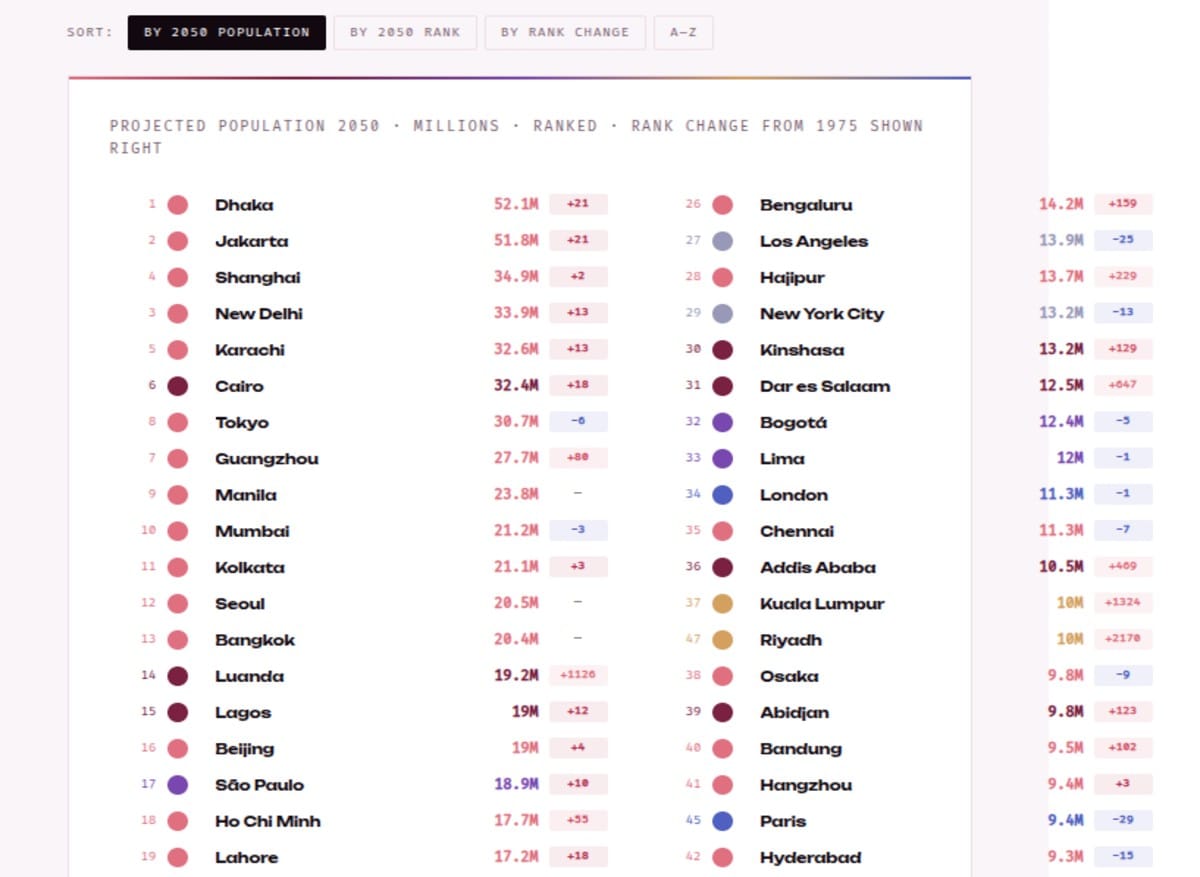
Projected Population 2050 · Millions · Ranked · Rank Change from 1975 shown right
Source: UN World Urbanization Prospects 2025 · City populations from satellite-mapped urban footprints · Rank change = 2050 rank vs 1975 rank
Cities in Top 50 by Region · 2050 Projections
52.1M
Dhaka
#1 in 2050 · Up from rank 21 in 1975
#1 in 2050 · Up from rank 21 in 1975
+647
Dar es Salaam
Largest positive rank change — +647 since 1975
Largest positive rank change — +647 since 1975
−35
Tehran
Largest fall — declining fertility + emigration
Largest fall — declining fertility + emigration
+2,170
Riyadh
Largest ever rank rise — from small city to megacity
Largest ever rank rise — from small city to megacity
The Coming Urban Hierarchy
The list of the world's most populous cities in 2050 looks almost nothing like the list of 1975 — and the divergence tells the story of where human development is concentrating in the 21st century. In 1975 the list was dominated by established industrial metropolises: New York, Tokyo, Shanghai, London, Osaka, Moscow. By 2050, the UN's projections show Dhaka (52.1 million), Jakarta (51.8 million), New Delhi (33.9 million), Shanghai (34.9 million), Cairo (32.4 million), and Karachi (32.6 million) at the top — a list in which every city but Shanghai is in South Asia, Southeast Asia, or Africa. The urbanisation wave that created 20th-century megacities in East Asia and Latin America is in the 21st century concentrated in South Asia and Sub-Saharan Africa — the two regions where both natural population growth and rural-to-urban migration rates are highest.
The rank changes from 1975 to 2050 are the most revealing single data series in this dataset. Dhaka's rise from approximately rank 21 in 1975 to #1 in 2050 reflects Bangladesh's extraordinary demographic trajectory: the country has urbanised at rates that were historically unusual for a nation with its income level, with Dhaka absorbing migrants from rural Bangladesh's agricultural hinterland at a pace that has made it one of the fastest-growing large cities in human history. Dar es Salaam's +647 rank improvement reflects Sub-Saharan Africa's broader urbanisation explosion — a continent that was predominantly rural in 1975 and will be predominantly urban by 2050, with the majority of that urban population concentrated in a relatively small number of rapidly expanding cities.
In 1975, New York was the world's most populous city. By 2050, the UN projects Dhaka — Bangladesh's capital — at 52 million people. That shift is not just a demographic fact. It is a realignment of where economic activity, political power, and human aspiration will be concentrated for the rest of the century.
Tokyo's Graceful Decline
Tokyo's trajectory in this dataset is instructive precisely because of what doesn't happen to it. The city remains among the world's largest in 2050 — projected at approximately 30.7 million — but it has fallen substantially in rank from its peak as the world's most populous city in the 1990s and 2000s. Tokyo's relative decline is a consequence of Japan's demographic implosion: the country's total fertility rate has been below replacement for 50 consecutive years, its population has been declining in absolute terms since approximately 2010, and Tokyo itself has maintained its size primarily through continued domestic migration from Japanese regions as young people leave declining provincial cities for the relative economic dynamism of the capital. Tokyo's 2050 population will likely be lower than its 2025 population in absolute terms — its rank decline is not a story of urban failure but of a national demographic correction that no city policy can reverse as long as Japan's birth rate remains at current levels.
The contrast between Tokyo and the cities around it in the top 10 is stark. While Tokyo declines in absolute and relative terms, Dhaka and Jakarta are projected to grow by tens of millions. This contrast — the world's most efficiently managed megacity declining while its demographically explosive peers surge — illustrates the degree to which urban population trajectories are determined by national demographics rather than city-level governance quality.
Africa's Urban Explosion
The Sub-Saharan African cities in this dataset represent the most dramatic urbanisation story in the projections. Kinshasa (32+ million), Dar es Salaam (25 million), Lagos (implicit in the data), Luanda, and multiple smaller cities are growing at rates that will transform the African continent's settlement geography by mid-century. The drivers are the same ones that drove Asian urbanisation in the 20th century: fertility rates that are producing large youth cohorts, agricultural mechanisation and consolidation that is displacing rural labour, and the concentration of formal employment opportunities in urban areas. The critical difference from the Asian urbanisation experience is that African cities are urbanising at income levels substantially lower than East Asian cities urbanised — meaning the infrastructure investment, formal housing construction, and formal employment creation that would theoretically accompany urbanisation is happening more slowly than the population migration itself.
The result is the rapid growth of informal settlements — slums — in Sub-Saharan African cities. Dar es Salaam, Kinshasa, and Luanda have some of the world's largest proportions of urban populations living in informal housing. The 2050 projected populations of these cities are not predictions of orderly urban development — they are projections of human concentration that will occur regardless of whether the infrastructure to support it is built. Whether the urbanisation of Sub-Saharan Africa produces the productivity gains and living standard improvements that Asian urbanisation produced depends almost entirely on investment decisions that have not yet been made — in transport infrastructure, formal housing, water and sanitation, schools, and health facilities.
The Middle East Anomaly: Riyadh's +2,170
Riyadh's rank change of +2,170 — the largest in the dataset — reflects a trajectory that has no parallel in modern urban history. In 1980 (the earliest available data for Riyadh), the city had a population of approximately 877,000. By 2025 it has grown to approximately 9.5 million, and projections suggest continued growth to approximately 10+ million by 2050. This trajectory — from a large town to a top-50 global megacity in 70 years — was powered by oil wealth that funded urban infrastructure at a pace impossible in most of the world, combined with large-scale immigration of construction and service workers from South and Southeast Asia who built and maintain the city. The Riyadh story is essentially a resource-funded construction of a city ex nihilo — and the sustainability of its continued growth depends on Saudi Arabia's economic diversification agenda succeeding in creating non-oil employment that justifies the city's scale in a post-petroleum economic scenario.
End of Brief · Prism
