McDONALD'S 40,000 LOCATIONS
Prism · Brands & Globalisation
McDonald's · 2024
40,000
LOCATIONS There are 40,000 McDonald's worldwide — and over half of them are in just three countries: the United States, China, and Japan. The geography of the world's most recognised brand tells a story about wealth, urbanisation, and the specific conditions that turn a fast-food chain into infrastructure.
Total: ~40,000 McDonald's locations globally · Data as of 2024
Australia includes American Samoa, Fiji, New Caledonia, Tahiti, Western Samoa
UK includes Isle of Man, Jersey, N. Ireland, Scotland, Wales · France includes Monaco
Note: In 2022, McDonald's exited Russia and sold its 850 locations (now "Vkusno i tochka")
Australia includes American Samoa, Fiji, New Caledonia, Tahiti, Western Samoa
UK includes Isle of Man, Jersey, N. Ireland, Scotland, Wales · France includes Monaco
Note: In 2022, McDonald's exited Russia and sold its 850 locations (now "Vkusno i tochka")
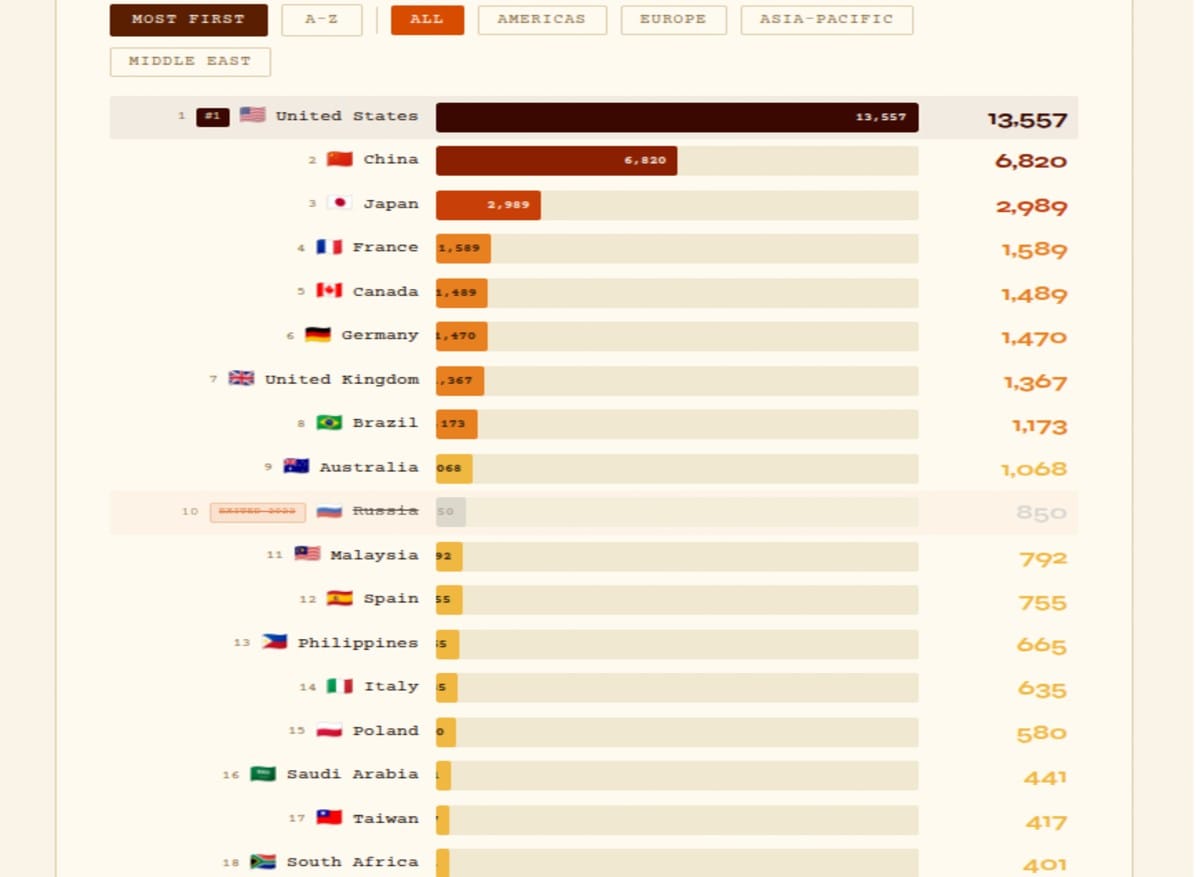
🍔 The 3-country concentration: USA (13,557) + China (6,820) + Japan (2,989) = 23,366 locations — over 58% of all McDonald's worldwide in just 3 countries with 14% of world population.
McDonald's Locations by Country · Absolute Count · 2024
Hover for detail · Bars scaled to 13,557 (US)
Filter by region
Filter by region
🥇 Most Locations
🇺🇸 United States
13,557
33.9% of global total
🥈 #2 Country
🇨🇳 China
6,820
17.1% of global total
🥉 #3 Country
🇯🇵 Japan
2,989
7.5% of global total
🇨🇺 Cuba: The only McDonald's in Cuba is on the Guantanamo Bay Naval Base — not accessible to Cuban citizens.
🇷🇺 Russia: In 2022, McDonald's exited Russia after 32 years and sold its 850 locations. They now operate as "Vkusno i tochka" ("Tasty and that's it").
🌍 Africa: Africa's first McDonald's opened in Morocco in 1992. South Africa (401) remains the continent's largest market.
Source: McDonald's · Data as of 2024 · Note inclusions: Australia+Pacific islands, UK+Crown Dependencies, France+Monaco
13,557USA
#1 Absolute
#1 Absolute
6,820China
Fastest Growth
Fastest Growth
40,000Total Global
Locations
Locations
850Russia Exit
2022 (sold)
2022 (sold)
The Three-Country Concentration
McDonald's has approximately 40,000 locations worldwide. The United States alone has 13,557 — roughly one in three of all McDonald's on Earth. Add China (6,820) and Japan (2,989), and you have accounted for 58% of the entire global network in three countries that together hold about 14% of the world's population. This concentration is the most important fact in the McDonald's location dataset, and it illustrates something that simple global totals obscure: McDonald's is not primarily a global brand — it is a brand that operates at scale in a small number of wealthy, urbanised markets and maintains a presence in dozens of others without reaching meaningful density.
The United States' 13,557 locations represent a market that has been McDonald's operational core for its entire history. The suburban drive-through format that characterises American McDonald's — large lots, extensive parking, dual drive-through lanes — is economically viable only in the kind of car-centric, low-density suburban geography that the United States has in abundance. This explains why the American location count is not replicated in European countries of comparable wealth: European urban density, smaller land parcels, and more developed public transit systems limit the drive-through model that drives American unit economics.
The United States, China, and Japan together account for 58% of all McDonald's worldwide — in countries with 14% of the world's population. McDonald's at scale is a story about three markets, not a global story.
China's 6,820: The Growth Frontier
China's 6,820 locations represent both McDonald's largest international market and its fastest-growing one. China's McDonald's network has grown from approximately 2,000 locations a decade ago to nearly 7,000 today, and the company has announced ambitious expansion targets — aiming for 10,000 Chinese locations before 2028. This growth is driven by China's continuing urbanisation, the expansion of a middle-class population with disposable income for branded food service, and the maturation of China's commercial real estate market in second- and third-tier cities where Western food brands are increasingly establishing a presence after saturating first-tier markets.
McDonald's China is majority-owned by CITIC and Carlyle Group after a 2017 deal, giving it a Chinese institutional structure that arguably provides better access to Chinese urban development pipelines and government relationships than a fully foreign-owned operation would. The growth of China's McDonald's network has happened simultaneously with the emergence of powerful domestic fast-food competitors — Luckin Coffee, Haidilao, and dozens of regional chains — but McDonald's has maintained its position partly by adapting its menu to Chinese tastes (rice dishes, congee, taro items) and partly by leveraging its brand recognition and operational consistency in a market that still values established international brands as quality signals.
Japan's 2,989: The Mature Asian Market
Japan's 2,989 locations make it McDonald's third-largest market by absolute count and one of its most profitable. McDonald's entered Japan in 1971 — the first Western fast-food company to enter the Japanese market — and has been present for over fifty years. Japan's McDonald's operations are run by McDonald's Holdings Company Japan, which is publicly listed on the Tokyo Stock Exchange, making it one of the few markets where local investors can directly access McDonald's returns.
Japan's McDonald's is notable for the quality of its regional menu adaptation. Teriyaki burgers, Matcha McFlurries, Tsukimi (moon-viewing) seasonal items, and a generally higher standard of food quality than American McDonald's reflect decades of adaptation to Japanese consumer expectations. Japan is a useful case study in how global brands must localise to achieve sustainable depth in culturally assertive markets — the Japanese consumer's exceptionally high expectations for food quality and service precision forced McDonald's to operate at a standard that is visible in customer satisfaction metrics substantially above the global average.
Russia's Exit: The 2022 Geopolitical Rupture
McDonald's entry into the Soviet Union in 1990 — the first Western fast-food restaurant in Moscow, which drew queues of thousands on its opening day — was one of the iconic images of the Cold War's end. The company had operated in Russia for 32 years by the time it announced in May 2022, following Russia's invasion of Ukraine, that it would exit the Russian market and sell its approximately 850 locations.
The Russian locations were sold to a Siberian licensee and rebranded as "Vkusno i tochka" ("Tasty and that's it") — maintaining the same physical spaces and largely the same menu while attempting to reassure Russian consumers that the product quality would be maintained without the Western brand. The exit cost McDonald's approximately $1.4 billion in charges. It was among the largest corporate exits from Russia in 2022, and it effectively ended a 32-year presence that had symbolised, perhaps more than any other commercial relationship, the post-Cold War integration of Russia into global consumer capitalism. The Vkusno i tochka rebranding is, in a small way, a monument to the reversal of that integration.
Europe: Present but Not Dominant
Europe's McDonald's presence — Germany (1,470), France (1,589), UK (1,367), Spain (755), Italy (635), Poland (580) — reveals the limits of the American fast-food model in European markets. France is notable as McDonald's second-largest European market and the country most often cited as a cultural resistance zone for American food — yet France has 1,589 locations, suggesting that the resistance is cultural commentary rather than commercial reality. French McDonald's locations are often architecturally adapted to their surroundings and serve wine in some locations, a level of local integration that the brand has pursued specifically to reduce cultural friction.
Germany's 1,470 and the UK's 1,367 reflect similarly mature but stable Western European markets where growth is incremental rather than dramatic. Poland's 580 and the broader Eastern European market represent a growth zone that has expanded significantly since EU accession in the 2000s, as rising middle-class incomes have created demand for branded food service in markets that were largely absent from Western fast-food networks during the Soviet era.
The India Absence, Again
India does not appear in this dataset with a named figure — reflecting the reality that despite being the world's most populous country, India has fewer than 600 McDonald's locations. This is explored in the per-capita companion piece, but the absolute number makes the point even more starkly: Indonesia (236), Thailand (260), Malaysia (792), and Vietnam are all countries with McDonald's presences that are contextually substantial. India, with 1.45 billion people and a growing middle class, is structurally underserved by McDonald's at the absolute location level as well.
The Indian franchise disputes — complex multi-year legal battles between McDonald's and its Indian franchisees, Connaught Plaza Restaurants (north and east India) and Hardcastle Restaurants (west and south India) — have directly limited expansion. Unlike China's clean institutional structure (CITIC/Carlyle as majority owners) or Japan's publicly listed subsidiary, McDonald's India has been hampered by franchise complexity that has constrained the capital investment and operational standardisation necessary for rapid network expansion. Resolving the franchise structure and aligning incentives for growth is arguably the single biggest near-term driver of whether McDonald's India reaches 1,000, then 2,000, then 5,000 locations in the decade ahead — a trajectory that, given India's demographics and urbanisation pace, is not implausible if the institutional barriers are removed.
End of Brief · Prism
