HOW INTEREST RATES MOVE REAL ESTATE
Prism · Real Estate & Rates
FRED / NAREIT · 2016–2025
INTEREST RATES
MOVE REAL ESTATE Zero rates drove the greatest real estate boom in a generation. The fastest rate hike cycle in forty years sent REITs crashing. Now cuts have resumed — and the next chapter for real estate investors may be the most consequential since 2020.
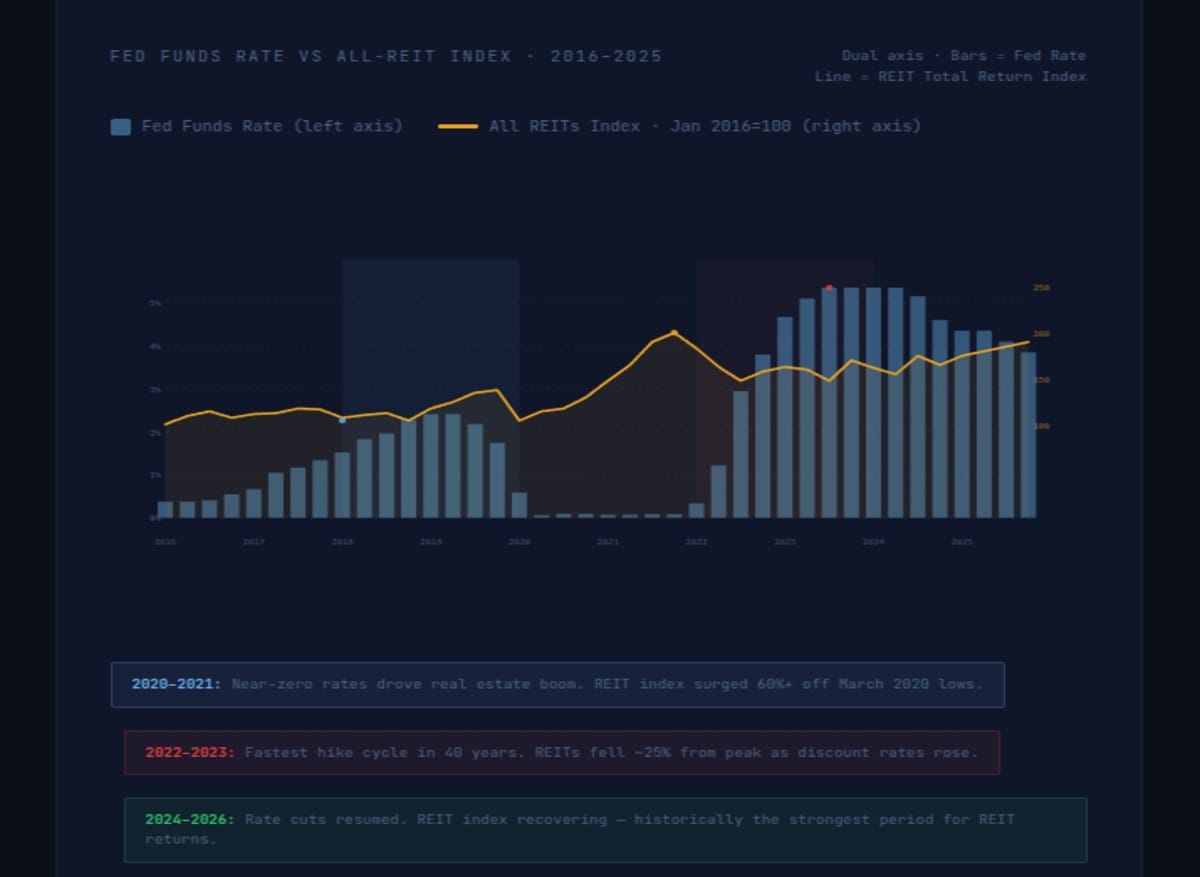
Left axis: Average Federal Funds Effective Rate (%) · Fed's benchmark overnight lending rate
Right axis: All REITs Total Return Index · January 2016 = 100 baseline
Sources: FRED (Federal Reserve Economic Data) · NAREIT (National Association of Real Estate Investment Trusts)
Right axis: All REITs Total Return Index · January 2016 = 100 baseline
Sources: FRED (Federal Reserve Economic Data) · NAREIT (National Association of Real Estate Investment Trusts)
📈 Forward outlook: With the Fed expected to keep cutting rates to a median target of 3.25–3.50% by mid-2026 year end, REIT investors could see a meaningful tailwind — provided inflation does not re-accelerate and force a policy reversal.
Fed Funds Rate vs All-REIT Index · 2016–2025
Dual axis · Bars = Fed Rate
Line = REIT Total Return Index
Line = REIT Total Return Index
Fed Funds Rate (left axis)
All REITs Index · Jan 2016=100 (right axis)
2020–2021: Near-zero rates drove real estate boom. REIT index surged 60%+ off March 2020 lows.
2022–2023: Fastest hike cycle in 40 years. REITs fell ~25% from peak as discount rates rose.
2024–2026: Rate cuts resumed. REIT index recovering — historically the strongest period for REIT returns.
Sources: FRED (Federal Reserve Economic Data) · NAREIT · Fed Funds Effective Rate: quarterly average · REIT Index: Jan 2016 = 100 baseline
5.33%Peak Rate
2023 High
2023 High
~270REIT Index Peak
2021 High
2021 High
3.25%Fed Target
Mid-2026 Median
Mid-2026 Median
~25%REIT Peak-to-Trough
2022 Decline
2022 Decline
The Mechanism: Why Rates Move Real Estate
The relationship between interest rates and real estate returns is one of the most consistent empirical patterns in financial markets, and understanding the mechanism helps explain why the 2016-2025 period is such a useful teaching case. REITs (Real Estate Investment Trusts) are particularly sensitive to interest rate movements for three distinct reasons that compound each other.
First, REITs are capital-intensive businesses that finance property acquisition and development with debt. When interest rates rise, the cost of that debt rises, reducing net operating income and compressing profit margins. Second, REITs are required by law to distribute at least 90% of their taxable income as dividends, which makes them function like bonds in investors' minds — when interest rates rise and bonds offer higher yields, REITs' dividend yields become relatively less attractive, causing their share prices to fall as investors rotate toward fixed income. Third, higher interest rates raise the "discount rate" used to value future cash flows — meaning that the present value of a REIT's future rental income falls when rates rise, even if the rental income itself is unchanged. All three mechanisms push in the same direction, which is why REIT returns are so highly sensitive to the interest rate environment.
The Fed cut rates from 5.25% to near zero in two weeks in March 2020. The All-REIT index subsequently more than doubled from its COVID lows. Rate cuts do not merely help REITs — in the right conditions, they ignite them.
2016–2019: The Gradual Normalisation
The 2016-2019 period illustrates a more nuanced aspect of the rate-REIT relationship: gradual, well-telegraphed rate increases do not necessarily crush REIT returns. The Federal Reserve raised its benchmark rate from near zero in December 2015 to 2.25-2.50% by December 2018 — nine increases over three years. During this period, the All-REIT index nonetheless rose modestly, reflecting the fact that the rate increases were occurring in the context of a strong economy (rising rents, high occupancy rates, strong employment) that supported the underlying real estate fundamentals.
The 2019 rate cuts — three 25 basis point reductions from July to October 2019, as the Fed responded to trade war uncertainty and slowing global growth — helped REITs recover from a 2018 softness and set the stage for what would become the most dramatic real estate market cycle in a generation. By late 2019, REITs had recovered and the index was reaching new highs, buoyed by the combination of rate cuts and continued strong real estate fundamentals.
2020: Zero Rates and the Real Estate Boom
The COVID-19 emergency forced the most dramatic monetary policy response in the Federal Reserve's history. In a period of approximately two weeks in March 2020, the Fed cut the federal funds rate from 1.75% to effectively zero — a scale and speed of easing without modern precedent. Combined with quantitative easing (the Fed purchasing $120 billion per month in Treasury bonds and mortgage-backed securities), the result was the loosest monetary conditions in American history.
The real estate market's response was extraordinary. After an initial March-April 2020 crash that briefly sent the REIT index below its 2016 baseline (nearly wiping out four years of returns), the combination of near-zero interest rates, fiscal stimulus (direct payments and enhanced unemployment benefits that sustained consumer spending), and surging demand for residential space drove a real estate boom of historic proportions. Home prices rose 40-50% in many markets between early 2020 and early 2022. The REIT index more than doubled from its COVID lows to reach its peak around early 2022. Near-zero rates were not merely a factor in the real estate boom — they were its primary engine.
2022–2023: The Fastest Hike Cycle in Forty Years
The Fed's inflation-fighting campaign of 2022-2023 was the fastest rate-increase cycle since the Volcker-era rate hikes of 1980-1981. From March 2022 to July 2023, the Fed raised its benchmark rate from near zero to 5.25-5.50% — eleven consecutive increases totalling 525 basis points. For REITs, the impact was severe and immediate: the All-REIT index fell approximately 25% from its 2021 peak through its 2023 trough, erasing a significant portion of the pandemic-era gains.
The 2022-2023 REIT selloff was driven by all three mechanisms described above, operating simultaneously at unprecedented speed. Cap rates (the ratio of net operating income to property value — the real estate equivalent of a price-earnings ratio) rose sharply as investors demanded higher returns to compensate for the availability of risk-free yields at 5%+. Transaction volumes collapsed as financing costs made deals unworkable. The commercial real estate market, already stressed by the work-from-home transition's impact on office occupancy, was hit particularly hard — office REITs fell 40-60% from peak as the combination of structural demand destruction and rate increases compounded each other.
2024 Onward: The Rate Cut Tailwind
The Fed began cutting rates in September 2024, reducing the federal funds rate by 100 basis points by the end of 2024. The REIT index has partially recovered, though it remains below its 2021 peak — reflecting both the recovering rate environment and the structural challenges still facing certain REIT subsectors (particularly office, which faces secular headwinds from remote work that are distinct from the cyclical interest rate pressure).
The historical pattern for REIT performance in rate-cutting cycles is consistent and significant. In the twelve months following the Fed's first rate cut in previous cycles (1995, 1998, 2001, 2007, 2019), the All-REIT index has outperformed broader equity indices in most instances. The mechanism is straightforward: as rates fall, the relative attractiveness of REIT dividend yields increases, cap rates compress (raising property values), and financing costs fall (improving REIT profit margins). If the Fed achieves a "soft landing" scenario — rates declining toward 3.25-3.50% without triggering a recession — the conditions for REIT outperformance may be as favourable as at any point since 2020.
The India Angle: REITs in a High-Rate Developing Market
India's REIT market is young — the first Indian REIT (Embassy Office Parks REIT) listed in 2019, with Mindspace Business Parks and Brookfield India following in 2020. The Indian REIT market currently covers primarily Grade A commercial office space, with limited residential and logistics exposure compared to American REITs. The total market capitalisation of Indian REITs remains a fraction of their American equivalents, but the structural case for growth is compelling: India's urban commercial real estate market is underpenetrated relative to the size of its services economy, and the formalisation of real estate investment through REIT structures is still in its early stages.
India's interest rate environment has been structurally different from America's — the Reserve Bank of India (RBI) manages rates in a context of higher baseline inflation and a different monetary transmission mechanism. But the fundamental relationship between rates and real estate returns operates in India as in the United States: the RBI's rate cycles have meaningfully influenced both the residential real estate market and the performance of listed Indian REITs. As India's capital markets mature and its REIT ecosystem expands beyond office space into retail, logistics, and potentially residential infrastructure, the interest rate-real estate dynamic will become an increasingly important factor for Indian investors to understand — not just as an American phenomenon, but as a universal feature of how capital markets price real assets.
End of Brief · Prism
