Global Births Per 1,000 People
Prism · Demography & Population
Global Births
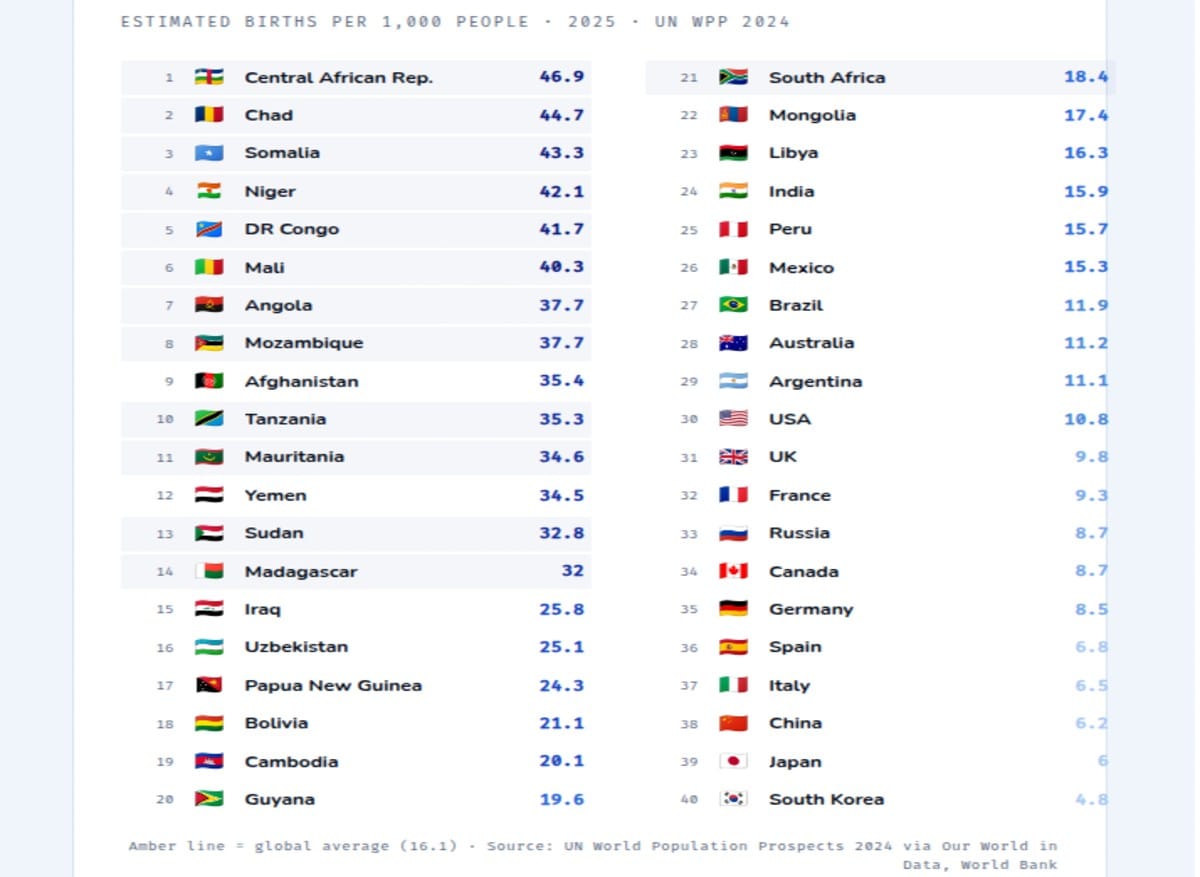
Per 1,000 People Estimated births per 1,000 population in 2025. The Central African Republic leads at 46.9 — nearly ten times South Korea's 4.8. The global average of 16.1 conceals a profound geographic split between rapidly reproducing Sub-Saharan Africa and a demographically collapsing East Asia.
Per 1,000 People Estimated births per 1,000 population in 2025. The Central African Republic leads at 46.9 — nearly ten times South Korea's 4.8. The global average of 16.1 conceals a profound geographic split between rapidly reproducing Sub-Saharan Africa and a demographically collapsing East Asia.
46.9
CAR — Highest
4.8
S. Korea — Lowest
16.1
Global Average
Highest Birth Rate
46.9
🇨🇫 Central African Republic
Per 1,000 people · 2025 est.
Global Average
16.1
🌍 World
CAR is 2.9× global average
Lowest Birth Rate
4.8
🇰🇷 South Korea
CAR is 9.8× South Korea
4.8 S. Korea
46.9 CAR →
Amber = global avg (16.1)
Sort:
Estimated Births Per 1,000 People · 2025 · UN WPP 2024
Amber line = global average (16.1) · Source: UN World Population Prospects 2024 via Our World in Data, World Bank
9.8×
CAR vs S. Korea
Largest birth rate gap between any two countries
Largest birth rate gap between any two countries
35+
African countries
Above the global average of 16.1
Above the global average of 16.1
6.0
China
Down to 6.0 — below Japan, a demographic shock
Down to 6.0 — below Japan, a demographic shock
10.8
United States
Below world average — continuing long-run decline
Below world average — continuing long-run decline
The Number That Determines Everything
The birth rate — measured as live births per 1,000 population — is the single most consequential number in long-run economics, geopolitics, and social policy. Countries with high birth rates are accumulating the human capital of future workers, consumers, soldiers, and taxpayers; countries with low birth rates are drawing down that capital at rates that no immigration policy or productivity growth can fully offset. The 2025 data showing a near-ten-fold difference between the Central African Republic (46.9) and South Korea (4.8) is not a temporary divergence that will converge as development proceeds — it is the current expression of a structural gap in demographic trajectories that has been widening for four decades and shows no near-term signs of closing. The countries with the highest birth rates are overwhelmingly the poorest; the countries with the lowest birth rates are overwhelmingly the wealthiest. The relationship between income and fertility is the most robust empirical regularity in modern demography.
The global average of 16.1 births per 1,000 population masks a bimodal distribution that a simple average cannot capture. Sub-Saharan Africa's rates cluster between 30 and 47; East Asia's cluster between 5 and 10; Western Europe, North America, and Australia cluster between 8 and 12. These are not points on a single spectrum — they are structurally different demographic regimes with different causes and different implications for economic and political futures. The global average is useful for tracking the trajectory of world population growth; it is almost useless for understanding the specific dynamics of any particular country or region.
South Korea's birth rate of 4.8 per 1,000 is among the lowest ever recorded for any substantial national economy. If sustained, it implies a halving of the South Korean population approximately every 35 years — a demographic trajectory with no modern parallel and no known policy cure.
Sub-Saharan Africa: The Demographic Engine
The concentration of the world's highest birth rates in Sub-Saharan Africa — with the Central African Republic (46.9), Somalia (43.3), Chad (44.7), Mali (40.3), Niger (42.1), and the Democratic Republic of Congo (41.7) all above 40 per thousand — reflects the region's position in the demographic transition. The demographic transition theory describes a predictable sequence: pre-industrial societies with high birth and death rates; early transition where death rates fall due to public health improvements while birth rates remain high; later transition as birth rates also fall; and post-transition at low birth and death rates. Sub-Saharan Africa is currently experiencing the high-birth-rate, declining-death-rate phase of the transition — the period that produced the highest population growth rates in Europe and Asia in their own 19th-century transitions.
Niger's 42.1 per thousand is particularly notable. Niger has the world's highest total fertility rate — approximately 6.9 children per woman — and one of the youngest median ages of any country at approximately 15 years. The combination means that Niger's current high birth rate will produce a large cohort of young adults in 15–20 years who will themselves be of reproductive age, creating a demographic momentum that will sustain high birth rates even if individual fertility intentions decline. This "momentum effect" means that demographic futures in sub-Saharan Africa are largely locked in for the next two decades regardless of any policy changes made today — the children who will be of reproductive age in 2040 have already been born.
East Asia's Demographic Collapse
South Korea's 4.8 per thousand — the lowest in the dataset — requires contextualisation that pure rate comparisons cannot provide. South Korea's total fertility rate has fallen to approximately 0.72 children per woman — the lowest ever recorded for any major economy in history. Japan's birth rate of 6.0 per thousand reflects a TFR of approximately 1.2, which is itself critically low. China's 6.2 — which places it below Japan — is perhaps the most geopolitically consequential data point in this dataset. China's birth rate has collapsed faster than any comparable economy in history, driven by the demographic legacy of the one-child policy, the dramatic increase in urban living costs, the educational pressure on young people, and shifting cultural attitudes toward marriage and parenthood. China's working-age population is already declining, and the demographic headwind to economic growth will intensify over the next two decades regardless of current policy.
The common explanation for East Asian demographic collapse — that higher income and better education reduce birth rates — is correct as far as it goes but incomplete. South Korea, Japan, and China all have birth rates substantially lower than equivalently wealthy European countries like France (9.3), Germany (8.5), and the UK (9.8). The East Asian shortfall relative to comparable-income countries reflects specific cultural and structural factors: extremely high housing costs in major cities relative to income, long working hours that are incompatible with childcare, educational systems that impose enormous private costs on families, gender norms that place a disproportionate parenting burden on women while expecting full labour force participation, and social norms around marriage that have delayed or suppressed family formation. The European welfare state has not solved low fertility — European birth rates are also below replacement — but it has prevented the catastrophic collapse visible in East Asia.
The Convergence That Isn't
Development economics predicted that birth rates would converge as global incomes converged — that sub-Saharan African fertility would follow the path of Asian fertility in the 20th century and decline toward replacement as education, urbanisation, and female labour force participation increased. This convergence is happening, but far more slowly than models predicted. Sub-Saharan African fertility rates have declined less rapidly than Asian rates did at comparable income levels, for reasons that are still debated: the specific structure of African economies, the role of land tenure and agricultural labour, the persistence of high infant mortality that creates insurance motives for large families, and the specific cultural and religious contexts of family formation. The result is that the demographic gap between Sub-Saharan Africa and the rest of the world is not narrowing at the pace that was anticipated — and the absolute population additions from Sub-Saharan Africa over the next 30 years will be substantially larger than models from 20 years ago projected.
End of Brief · Prism
