FAVORITE VALENTINE'S CANDY BY STATE
Prism · Consumer Culture
CandyStore.com · 2025
VALENTINE'S
CANDY BY STATE The heart-shaped box of chocolates dominates 15 states. Hershey's Kisses rules Texas. M&Ms claim the Northern Plains. And somewhere in Alabama, Candy Necklaces are having their moment. Valentine's candy is a $2.4B industry — and its geography reveals surprisingly deep patterns in American regional identity and consumer loyalty.
Source: CandyStore.com survey data · Favorite Valentine's Day candy by state · 2025
Based on online sales data and consumer surveys across the U.S. adult population
Heart-shaped box of chocolates is the single most popular item nationally · 15 states
Based on online sales data and consumer surveys across the U.S. adult population
Heart-shaped box of chocolates is the single most popular item nationally · 15 states
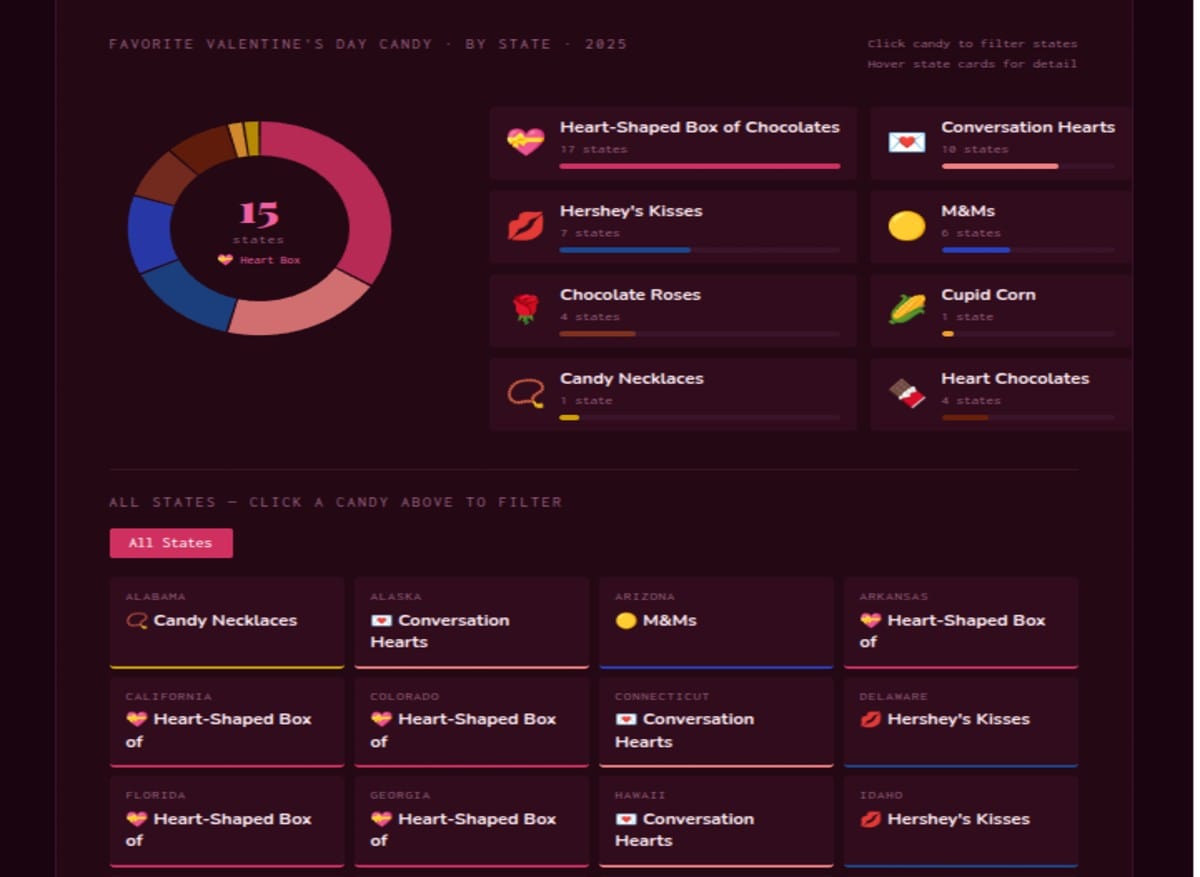
Favorite Valentine's Day Candy · By State · 2025
Click candy to filter states
Hover state cards for detail
Hover state cards for detail
15
states
💝 Heart Box
All States — Click a candy above to filter
Source: CandyStore.com · Favorite Valentine's Day candy by state · Based on sales data and consumer surveys · 2025
15States Love
Heart Box Choc.
Heart Box Choc.
8States Prefer
Conversation Hearts
Conversation Hearts
$2.4B est.Annual V-Day
Candy Market
Candy Market
8States Choose
M&Ms or Kisses
M&Ms or Kisses
🍫 The $2.4 Billion Love Letter
Valentine's Day is the second-largest candy holiday in America, behind only Halloween. Americans spend approximately $2.4 billion on Valentine's Day candy each year — roughly $24 per person who celebrates the occasion. The heart-shaped box of chocolates is the dominant product, chosen as the favourite in 15 states, and its continued dominance reflects something deeper than mere preference: it is a cultural script. The heart-shaped box of chocolates does not primarily communicate "I enjoy these particular chocolates" — it communicates "I am participating in the ritual of Valentine's Day in the most legible way possible." It is the greeting card of confectionery.
The geography of Valentine's candy preferences is a genuine data point about regional consumer culture, even when the differences seem trivial. Consumer preference surveys and sales data consistently reveal geographic clustering that goes beyond random variation — some preferences are regionally coherent enough to suggest genuine local taste differences, cultural transmission through family traditions, or the influence of regional retail distribution. The fact that Cupid Corn — a Valentine's-themed version of candy corn — is a favourite in Michigan may reflect nothing more than proximity to a Midwest manufacturing tradition or a retail chain's promotional strategy, but it might also reflect genuine regional willingness to engage with retro candy that is less fashionable in coastal markets.
The heart-shaped box of chocolates does not say "I chose these chocolates for you." It says "I love you" in the most universally legible format American consumer culture has produced. That's its actual function — and why it dominates 15 states.
💋 Hershey's Kisses: Texas and the West
Hershey's Kisses' dominance in Texas — the second most populous state in America — and across parts of the West reflects the brand's extraordinary staying power as a mass-market chocolate confection. Hershey's Kisses were introduced in 1907 and have been a Valentine's staple for decades, with the foil-wrapped teardrop shape making them visually distinctive and their individually wrapped format making them easy to share, distribute in school Valentine exchanges, and present as a semi-formal gift.
Hershey's has invested heavily in seasonal marketing for Valentine's Day, producing special edition foil colours (red, pink, silver) and branded varieties (Dark Chocolate Kisses, Hugs — white chocolate wrapped in milk chocolate) that maintain the product's cultural relevance across generations. The brand's dominance in Texas may partly reflect the state's historically strong connection to American mainstream brands over more artisanal or regional alternatives — Texas is a mass-market consumer state in ways that the coastal states are increasingly not.
🍬 Conversation Hearts: The Nostalgia Vote
Conversation Hearts — the chalky, pastel-coloured candy tablets with printed messages ("BE MINE," "TRUE LOVE," "SWEET PEA") — are one of America's oldest candy traditions, manufactured since 1866 by the New England Confectionery Company (Necco). Their enduring popularity in eight states, mostly in the Northeast and Northwest, reflects their extraordinary nostalgic resonance: no other Valentine's candy has quite the same generational transmission, with parents buying the same candy they received as children in school Valentine exchanges.
Conversation Hearts had a crisis moment in 2019 when Necco went bankrupt and a new owner (Spangler Candy Company) bought the brand. The 2019 Valentine's Day season saw a shortage of Conversation Hearts for the first time in decades — and the shortage itself became a cultural event, with consumers discovering that they apparently loved Conversation Hearts more in their absence than in their presence. The crisis also revealed that Spangler's 2019 batch had different texture and flavour than the original Necco product, prompting a backlash from purists. By 2020 and beyond, production had been normalised — but the episode illustrated how deeply embedded some food products are in cultural ritual, such that their absence feels like the loss of a tradition rather than simply an inconvenient product shortage.
🟡 M&Ms: The Northern Plains and Maryland
M&Ms' strength in North Dakota, Minnesota, Iowa, and Maryland suggests something about the particular intersection of family-oriented holiday gifting and the appeal of a shareable, non-messy chocolate format. M&Ms in Valentine's red and pink packaging are a classic school-party candy — easy to distribute, non-melting, and associated with cheerful celebration rather than romantic formality. Their popularity in the Northern Plains states may partly reflect the region's strong traditions of community celebration, school Valentine's parties, and family-oriented holiday participation that makes a casual, shareable candy more appealing than the intimate formality of a heart-shaped box.
💝 Chocolate Roses and Regional Whimsy
Chocolate Roses — chocolate moulded into rose shapes or shaped like a Hershey's Kiss with a rose motif — dominate Wyoming, New Mexico, and Kentucky. Their appeal combines the romantic symbolism of flowers with the indulgence of chocolate in a novelty format that feels both whimsical and gift-appropriate. Wyoming and New Mexico's preference for this category likely reflects a preference for novelty gifts in states where artisanal chocolate alternatives are less available, and where the visual drama of a chocolate rose appeals to a gift-giving sensibility that values form as much as flavour.
Alabama's Candy Necklaces — wearable confectionery at the intersection of jewellery and candy — and Michigan's Cupid Corn represent the dataset's most distinctive regional preferences. These are candies with almost no pretence of romantic formality; they are kid-coded, retro, and playfully absurd. Their emergence as state favourites suggests that in some markets, Valentine's Day is being celebrated with an emphasis on fun and nostalgia over the romantic conventions that dominate the national conversation about the holiday.
What Valentine's Candy Actually Tells Us
The Valentine's Day candy map is a small but genuine window into American consumer psychology. It reveals a market that is simultaneously dominated by powerful national brand scripts (the heart-shaped box, Hershey's Kisses, M&Ms — all brands with century-plus histories) and inflected by regional preferences that resist homogenisation. The dominance of the heart-shaped box of chocolates in 15 states tells us that Americans largely participate in holiday rituals through standardised formats; the persistence of Conversation Hearts tells us that nostalgia is commercially potent; the Alabama Candy Necklaces tell us that not everyone takes Valentine's Day as seriously as the industry might prefer.
The $2.4 billion Valentine's candy market is one of the clearest examples of what economists call "socially embedded consumption" — purchases driven not primarily by the intrinsic qualities of the product but by the social meaning of the act of purchase. Nobody buys a heart-shaped box of chocolates because they have conducted a blind taste test and concluded that the chocolates inside are superior to alternatives. They buy it because it communicates something legible to a recipient, and because participating in the ritual of Valentine's gift-giving has social value independent of the product's quality. Understanding this distinction — between consumption driven by product qualities and consumption driven by social scripts — is central to understanding why brands like Hershey's and Russell Stover can charge premium prices for products whose quality is merely adequate. The heart-shaped box isn't selling chocolates. It's selling participation in a ritual. And that, it turns out, is worth $2.4 billion a year.
End of Brief · Prism 💝
