
EUROPE'S SALARY DIVIDE
Prism · Labour & Economics
Eurostat · OECD · 2024
EUROPE'S
SALARY
DIVIDE
Luxembourg pays €83,000 average full-time salary. Bulgaria pays €15,400. The 5.4× gap between the highest and lowest average salary in Europe is not a curiosity — it is the defining labour market fact of a continent that shares a single market but not a single standard of living. The Nordic countries cluster €46–77K; Eastern Europe clusters €15–29K. One continent, two wage worlds.
Metric: Average annual full-time salary in euros · 2024
Range: Luxembourg €83,000 (highest) — Bulgaria €15,400 (lowest) · 5.4× gap
Nordic cluster: Iceland €77.2K · Denmark €71.6K · Norway €64.0K · Finland €49.4K · Sweden €46.5K
Source: Eurostat · OECD · 2024
Range: Luxembourg €83,000 (highest) — Bulgaria €15,400 (lowest) · 5.4× gap
Nordic cluster: Iceland €77.2K · Denmark €71.6K · Norway €64.0K · Finland €49.4K · Sweden €46.5K
Source: Eurostat · OECD · 2024
Prism Desk·Source: Eurostat · OECD·2024
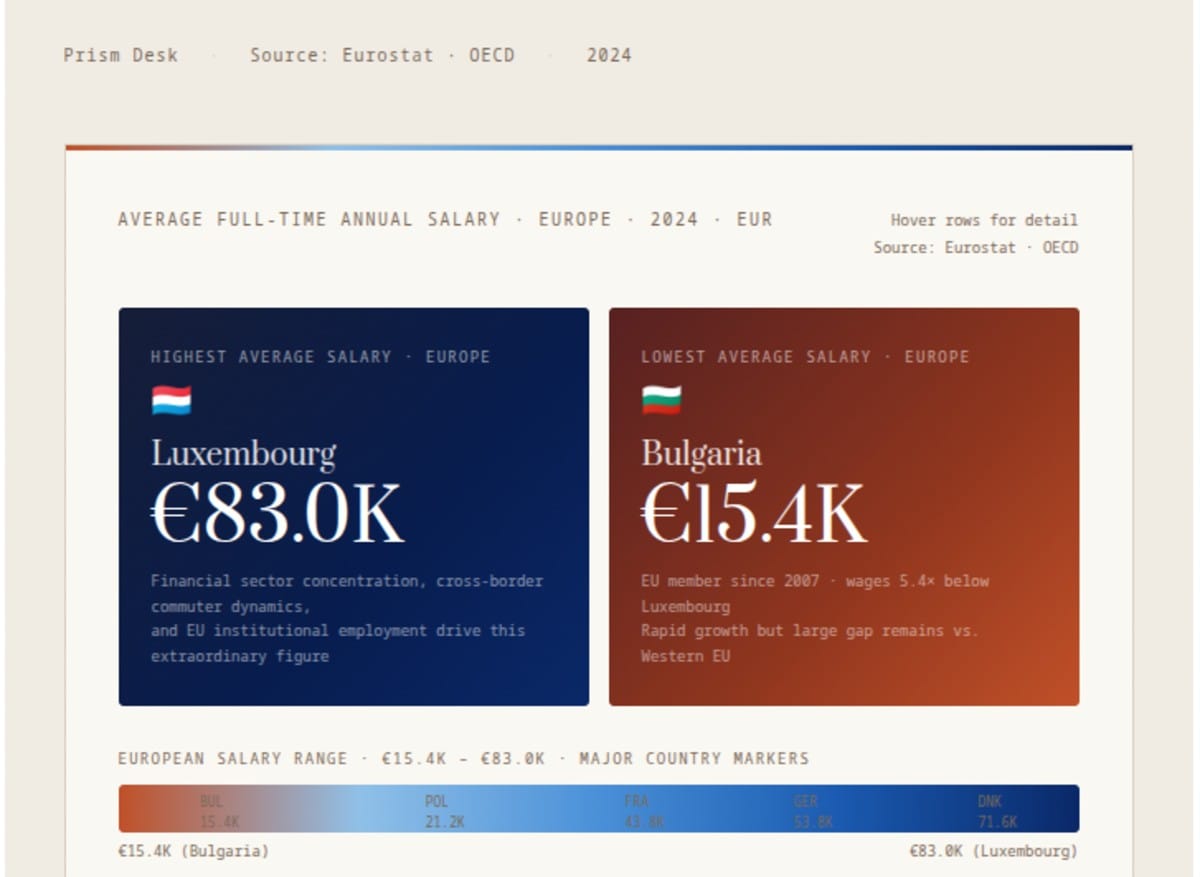
Average Full-Time Annual Salary · Europe · 2024 · EUR
Hover rows for detail
Source: Eurostat · OECD
Source: Eurostat · OECD
Highest average salary · Europe
🇱🇺
Luxembourg
€83.0K
Financial sector concentration, cross-border commuter dynamics,
and EU institutional employment drive this extraordinary figure
and EU institutional employment drive this extraordinary figure
Lowest average salary · Europe
🇧🇬
Bulgaria
€15.4K
EU member since 2007 · wages 5.4× below Luxembourg
Rapid growth but large gap remains vs. Western EU
Rapid growth but large gap remains vs. Western EU
European salary range · €15.4K – €83.0K · major country markers
€15.4K (Bulgaria)€83.0K (Luxembourg)
Western/Nordic Top 5
€64.5K
Avg of Luxembourg · Iceland · Switzerland
Denmark · Norway · Finland
All above €64K
Denmark · Norway · Finland
All above €64K
Eastern EU Bottom 5
€18.9K
Avg of Bulgaria · Hungary · Greece
Romania · Slovakia
All below €21K
Romania · Slovakia
All below €21K
Nordic + Benelux€46–83KLuxembourg · Iceland · CHE
Denmark · Norway · Finland
Belgium · Netherlands
Denmark · Norway · Finland
Belgium · Netherlands
Core Western Europe€34–62KAustria · Germany · UK
Ireland · Sweden · France
Italy · Spain · Malta
Ireland · Sweden · France
Italy · Spain · Malta
Eastern Europe€15–35KPoland · Czechia · Hungary
Romania · Bulgaria · Latvia
Lithuania · Slovakia · Croatia
Romania · Bulgaria · Latvia
Lithuania · Slovakia · Croatia
Purchasing power caveat: The nominal euro salary gap is wider than the purchasing-power-adjusted gap. A €21.2K salary in Poland buys more than a €21.2K salary in Germany, because Polish prices are substantially lower. Eurostat PPP-adjusted comparisons reduce the Eastern-Western gap by approximately 30–40%. But the nominal figures matter for cross-border mobility decisions — an Eastern European worker considering emigration to Germany or Denmark is comparing nominal wages in the same currency, not PPP-adjusted values.
Source: Eurostat · OECD · Average full-time annual salary · 2024 · Nominal euros
€83KLuxembourg
Highest Average
Highest Average
€15.4KBulgaria
Lowest Average
Lowest Average
5.4×Gap: Highest
vs. Lowest
vs. Lowest
€71.6KDenmark
Top EU Member
Top EU Member
One Market, Five Salary Worlds
The Eurostat and OECD data on average full-time salaries across Europe in 2024 presents a picture that is both familiar and arresting in its specific dimensions. The average full-time worker in Luxembourg earns €83,000 per year. The average full-time worker in Bulgaria earns €15,400. Both are citizens of the European Union, subject to the same single market rules, the same freedom of movement, the same product safety regulations, and the same financial sector oversight. The 5.4× salary gap between them is one of the largest between two countries in a nominally unified economic space in the developed world, and it reflects the specific history, industrial structure, and political economy of a continent that chose economic integration before it achieved economic convergence.
The salary map of Europe divides roughly into five horizontal bands. At the top sit the micro-states and Nordic countries — Luxembourg, Iceland, Switzerland, Denmark, Norway — where average salaries exceed €60,000 and the labour market is characterised by high productivity, significant unionisation, and sectoral concentration in high-value activities (finance, technology, energy, pharmaceuticals). Below them sits a Western European core — Belgium, the Netherlands, Germany, Austria, the UK, Ireland, Finland, Sweden — where average salaries of €43–60,000 reflect broad-based wealthy economies with strong manufacturing, services, and financial sectors. The Mediterranean tier — France, Spain, Italy, Malta, Portugal — clusters €24–44,000, reflecting economies with higher unemployment, lower productivity growth, and significant informal sector activity. Finally, Eastern Europe — the EU's 2004 and 2007 accession cohort — sits €15–35,000, still in convergence with the Western core 20 years after accession.
Luxembourg at €83K, Bulgaria at €15.4K. Both EU members. Both subject to the same single market rules. The 5.4× salary gap is the most honest summary of what European economic integration has and has not achieved in the 30 years since the Maastricht Treaty.
Luxembourg at €83,000: The Financial City-State Effect
Luxembourg's €83,000 average salary — the highest in Europe by a wide margin and nearly 50% above Denmark's €71,600 in second place — reflects a combination of factors that are specific to the peculiar economics of a small country that became the financial hub of the European Union almost by historical accident. Luxembourg hosts the European Court of Justice, the European Parliament (partially), the European Investment Bank, and several major EU regulatory bodies. It is the registered domicile of hundreds of European investment funds (the UCITS framework was designed in Luxembourg), the European headquarters of most major American technology companies (Amazon, PayPal, Skype, Apple's European operations), and a major private banking centre for continental European wealth.
The salary figure is significantly influenced by the cross-border commuter dynamic: approximately 45% of Luxembourg's workforce commutes daily from France, Belgium, and Germany, earning Luxembourg wages while living in lower-cost countries. This cross-border employment inflates the average salary figure relative to the living standards of Luxembourg residents, because many high-earning jobs are counted in Luxembourg's statistics even though their workers live elsewhere and spend their wages in other economies. The true standard of living in Luxembourg — while very high — is somewhat below what the €83,000 figure implies if interpreted as a single-country measure of household wellbeing.
Iceland, Switzerland, Norway: The Non-EU Premium
Iceland (€77,200), Switzerland (€75,100), and Norway (€64,000) are the three highest-salary non-EU European countries, and their positions illustrate the specific advantage of small, resource-rich or financially specialised economies outside the EU's regulatory and fiscal framework. None of the three is a full EU member (Switzerland and Iceland are EEA/EFTA members; Norway is EEA), though all participate in key aspects of the single market.
Iceland's extraordinary position — second in Europe at €77,200 — reflects the combination of a small highly educated population, significant natural resource wealth (geothermal and hydroelectric energy, fishing), and an economy rebuilt after the extraordinary 2008 banking collapse with a deliberately reduced financial sector exposure. Norwegian salaries reflect the sovereign wealth fund model: oil revenues have been systematically invested in the Government Pension Fund Global (now exceeding $1.7 trillion) and used to support public wages and social transfers that are reflected in the salary statistics. Switzerland's €75,100 reflects the productive structure of a country that has systematically concentrated in the highest-value segments of pharmaceuticals, financial services, precision machinery, and luxury goods — avoiding the lower-margin manufacturing and services industries that constrain wages in larger neighbours.
Denmark at €71,600: The Flexicurity Model
Denmark's €71,600 — the highest average salary among full EU member states — is the product of a specifically Danish institutional arrangement that labour economists call flexicurity: high labour market flexibility combined with high social security. Danish employers can hire and fire workers relatively easily compared to other European countries, which reduces the cost of employment and incentivises hiring. Workers accept this flexibility because Danish unemployment benefits are generous (up to 90% of previous salary for the first period), the state-funded retraining system is extensive, and the broader social safety net (healthcare, education, social care) reduces the stakes of job loss.
The result is high labour market dynamism — workers move between jobs more frequently than in Germany or France, which maintains allocative efficiency and prevents the wage compression that comes from long-term employment lock-in — combined with high wages that reflect the productivity gains from this dynamism. Danish trade unions are among the most embedded in the economy of any European country, covering approximately 65% of workers under collective agreements, which provides significant wage-setting power without the rigidity that makes some other European labour markets expensive for employers to navigate.
Denmark's €71,600 is not despite its labour market flexibility — it is partly because of it. Flexicurity creates dynamism that allocates workers to higher-productivity activities over time, producing the wage levels that justify generous social transfers. The model is the product, not the cause.
Germany at €53,800: The Industrial Wage
Germany's €53,800 — below Austria (€58,600), the Netherlands (€58,200), and Belgium (€59,600) despite having Europe's largest economy — reflects the specific wage structure of a country whose economy is built around manufacturing exports rather than financial services or technology. German industrial wages are high in absolute terms and reflect decades of wage-setting by the powerful IG Metall and other industrial unions, but the preponderance of manufacturing employment — which produces lower wages than equivalent hours in financial services or technology — pulls the average down compared to countries with more service-intensive economies.
Germany's wage structure also reflects the significant East-West internal gap that persists 35 years after reunification. Average wages in the former East German states (Saxony, Thuringia, Brandenburg, Mecklenburg-Vorpommern, Saxony-Anhalt) remain approximately 20-25% below West German wages for equivalent work, a gap that has narrowed but not closed despite sustained fiscal transfers from West to East totalling over €2 trillion since 1990. The aggregate German average of €53,800 masks a country with an internal salary geography that resembles the European East-West gradient in miniature.
Eastern Europe: 20 Years of Convergence That Isn't Finished
Poland (€21,200), Romania (€21,100), Hungary (€18,500), Slovakia (€20,300), Bulgaria (€15,400), Latvia (€22,300), Lithuania (€29,100), Czechia (€24,000), and Croatia (€23,400) joined the European Union between 2004 and 2013 with the explicit expectation that EU membership would drive convergence with Western European living standards through trade integration, foreign direct investment, and access to EU structural and cohesion funds. Two decades later, convergence has occurred — Polish wages have roughly tripled in nominal euro terms since 2004 — but the gap remains enormous. Poland at €21,200 is still only 25% of Luxembourg's average. Bulgaria at €15,400 is 18.5% of Luxembourg's.
The convergence has, however, produced a significant and underappreciated geopolitical effect: as Eastern European wages have risen, the cost advantage of Eastern European manufacturing and services has narrowed, reducing the economic incentive for emigration to the West. Poland's labour market is now tight — unemployment is low, wages are growing rapidly — and the net emigration of Poles to Germany and the UK that characterised the 2000s and 2010s has significantly decelerated, with some evidence of return migration. Romania and Bulgaria still show significant emigration pressure, particularly to Germany, Spain, and Italy, reflecting the larger remaining wage gap.
The salary data tells the story of European convergence honestly: it is happening, it is real, and it is nowhere near complete. The countries that acceded in 2004 are significantly closer to Western European wages than they were; the countries that acceded in 2007 (Bulgaria, Romania) remain far behind. At the rates of convergence observed over the past decade, Bulgaria would reach half of Luxembourg's salary in approximately 30 years — a timeline that exceeds the patience of Bulgarian workers who can move to Germany or Denmark today. The free movement of labour that is one of the EU's four fundamental freedoms is, simultaneously, the mechanism that allows the wage gap to partially self-correct and the mechanism that risks hollowing out the very labour forces whose productivity growth would close the gap from the inside.
End of Brief · Prism