Defense Spending Per Person
Prism · Defense & Geopolitics · SIPRI / World Bank
Defense Spending
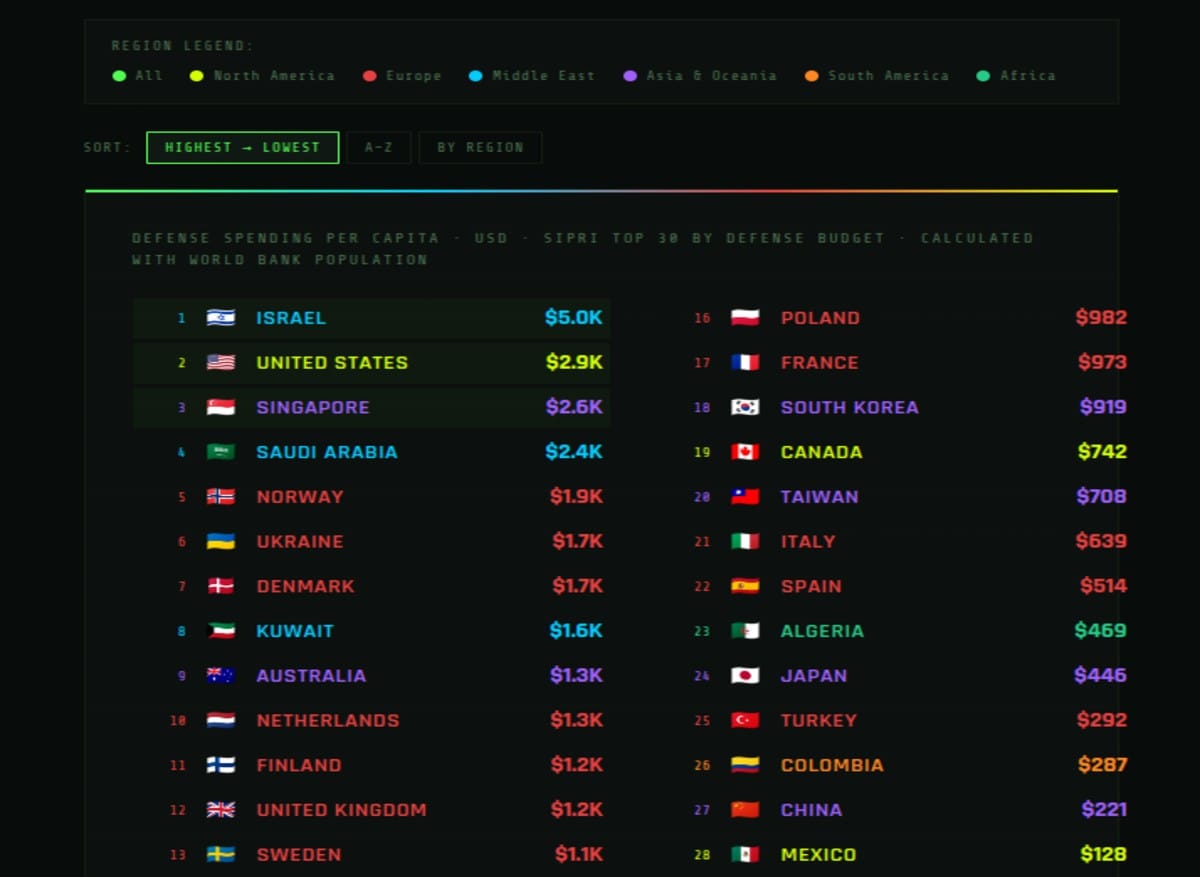
Per Person Israel spends $5,000 per person per year on defense — more than the United States ($2,900) and nearly ten times Germany ($1,000). The per-capita lens reveals the security calculus of states under existential threat, wealthy city-states, and NATO free-riders.
Per Person Israel spends $5,000 per person per year on defense — more than the United States ($2,900) and nearly ten times Germany ($1,000). The per-capita lens reveals the security calculus of states under existential threat, wealthy city-states, and NATO free-riders.
$5.0K
Israel — Highest
$2.9K
United States
$39
Indonesia — Lowest
Region Legend:
All
North America
Europe
Middle East
Asia & Oceania
South America
Africa
Sort:
Defense Spending Per Capita · USD · SIPRI Top 30 by Defense Budget · Calculated with World Bank Population
Source: SIPRI Top 30 Countries by Defense Spending · Per capita calculated using World Bank population figures · USD
$5,000
Israel
Per person · 10× Germany · Existential threat premium
Per person · 10× Germany · Existential threat premium
$2,900
United States
Still 2nd highest per capita despite scale advantage
Still 2nd highest per capita despite scale advantage
$2,600
Singapore
City-state with no strategic depth — geography forces spending
City-state with no strategic depth — geography forces spending
$39
Indonesia
Lowest · Archipelago geography + low threat perception
Lowest · Archipelago geography + low threat perception
Israel's Existential Premium
Israel's $5,000 per capita annual defense expenditure — the highest of any country in this dataset by a wide margin — is the price of continuous existential threat. No other wealthy democracy in the world faces the specific combination of geographic vulnerability, hostile state neighbours, non-state actor threats, and periodic armed conflict that Israel has experienced since its founding in 1948. The per-capita figure translates to approximately $50 billion in total annual defense spending for a population of approximately 10 million — a figure that would represent approximately 5% of GDP, far exceeding the NATO standard of 2% and placing Israel among the highest defense burden countries in the world by either absolute or per-capita measure.
The $5,000 per person is not merely a military expenditure — it funds a conscription-based military that trains virtually every Israeli citizen, a reserve system that can mobilise hundreds of thousands of soldiers within days, advanced domestic defense industry development (Israel is a significant defense technology exporter), and the Iron Dome, David's Sling, and Arrow layered air defense systems whose per-unit cost is substantial. Israel's per-capita defense spending is a measure of a society that has organised significant fractions of its economic and human capital around the preparation for conflict — a posture that has shaped Israeli society, culture, and politics in ways that are inseparable from its security environment.
Israel spends $5,000 per person on defense. Germany spends $1,000. The ratio tells you almost everything you need to know about the difference in threat perception between a country that has been in continuous conflict since its founding and one that has been at peace for 80 years. These are not irrational budget choices — they are rational responses to entirely different security environments.
Singapore's Geographic Necessity
Singapore's $2,600 per capita — third highest globally, behind only Israel and the United States — is the defense expenditure of a city-state that has no strategic depth. Singapore is 730 square kilometres with no hinterland, no buffer zone, and no second line of defence. If Singapore's border is breached, Singapore falls. This geographic reality has driven the country's defense posture since independence in 1965: the Singapore Armed Forces are among the most well-equipped and well-trained per-capita militaries in the world, reflecting a deliberate policy choice to substitute quality and technology for the mass that size cannot provide. Singapore's defense spending is not primarily about deterring a specific identified threat — it is a structural response to geographic vulnerability that has been consistent across every Singaporean government since Lee Kuan Yew.
Singapore's defense doctrine is explicitly based on the "poisoned shrimp" concept: the idea that Singapore, while small, should be so difficult to attack and occupy that the military cost of doing so would outweigh any strategic benefit. High per-capita defense spending is the operational expression of this doctrine — maintaining armed forces capable enough that no rational adversary would find the cost-benefit calculation of aggression favourable.
The NATO Gap: Germany at $1,000
Germany's $1,000 per capita — less than one-fifth of Israel's and roughly one-third of the United States' — captures the central tension in NATO burden-sharing that has defined transatlantic security politics since the Cold War ended. Germany is Europe's largest economy, NATO's most populous European member, and geographically the member with perhaps the most strategic responsibility in any credible Russia-NATO scenario. Yet its per-capita defense spending has historically been among the lowest in the Alliance. The Zeitenwende (turning point) announced by Chancellor Scholz following Russia's February 2022 invasion of Ukraine — committing to a €100 billion special defence fund and 2% GDP military spending — was described as a historic shift precisely because it was departing from a 30-year norm of structural under-investment.
Germany's lower-than-peers per-capita figure reflects decisions made in the post-Cold War "peace dividend" period that are now being unwound under the pressure of the Ukraine war and sustained US pressure on burden-sharing. The US has repeatedly — across Democratic and Republican administrations — argued that European NATO members are benefiting from American security guarantees while under-investing in the collective defense that makes those guarantees credible. The per-capita comparison makes this argument concrete: at $1,000 per German versus $2,900 per American, the differential is not marginal.
Ukraine's War Economy
Ukraine's $1,700 per capita — higher than France, higher than the UK, higher than Germany — reflects the extraordinary reality of a country in active high-intensity warfare. Ukraine's total defense spending has been transformed by the 2022 invasion from a relatively modest percentage of GDP to an economy-defining expenditure. The per-capita figure is striking precisely because Ukraine's pre-war GDP per capita was approximately $3,900 — meaning the country is spending roughly 43 cents of every dollar of per-capita economic output on defense. This level of military mobilisation has no precedent in recent European history and is being sustained only by substantial external financial support from the US, EU, and allied nations. The per-capita figure in the SIPRI data represents both domestic expenditure and the foreign-funded component that is being channelled through Ukrainian defense budgets.
The Gulf: Per-Capita Wealth Meets Strategic Anxiety
Saudi Arabia ($2,400 per capita) and Kuwait ($1,600) reflect the Gulf states' combination of high per-capita wealth and acute regional security concerns. Saudi Arabia has been engaged in a costly military intervention in Yemen since 2015 and faces both Iranian state threats and non-state actor risks that drive sustained high defense investment. Kuwait's per-capita figure is elevated by the memory of Iraq's 1990 invasion and occupation — a formative national trauma that has sustained higher defense spending than Kuwait's relatively small military forces might otherwise require. The Gulf defense expenditure is, in per-capita terms, substantially inflated by the region's oil wealth relative to population size — the Saudi per-capita figure would be substantially lower if measured against total resident population including the large expatriate workforce that contributes to GDP but has no defense obligation.
End of Brief · Prism
