Countries with the Most Top-Rated Hospitals
Prism · Healthcare & Hospital Rankings
Countries with the Most
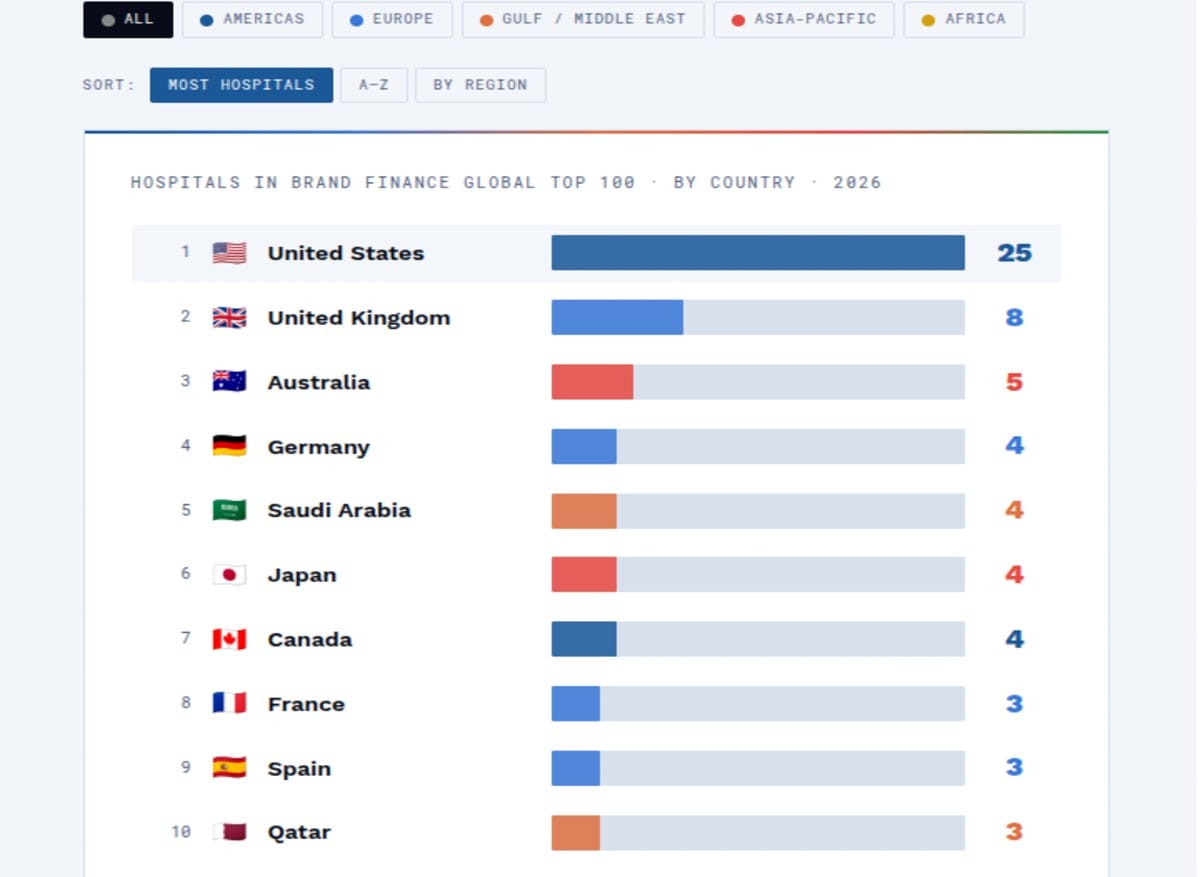
Top-Rated Hospitals The United States places 25 hospitals in Brand Finance's Global Top 100 — more than the next five countries combined. The Gulf states' surprising presence and Asia's underrepresentation relative to population tell important stories about where elite hospital infrastructure is being built.
Top-Rated Hospitals The United States places 25 hospitals in Brand Finance's Global Top 100 — more than the next five countries combined. The Gulf states' surprising presence and Asia's underrepresentation relative to population tell important stories about where elite hospital infrastructure is being built.
Methodology: Brand Finance's Global Top 250 Hospitals are ranked using a Brand Strength Index survey of 2,500 healthcare professionals globally. The numbers shown are hospitals in each country's Top 100.
25
U.S. hospitals in top 100
8
UK — 2nd most
30+
Countries represented
Sort:
Hospitals in Brand Finance Global Top 100 · By Country · 2026
Source: Brand Finance Global Top 250 Hospitals 2026 · Based on Brand Strength Index survey of 2,500 healthcare professionals
Americas
34
US · Canada · Colombia · Brazil · Argentina
Europe
23
UK · Germany · France · Spain · Sweden · 4 others
Gulf / MENA
18
Saudi Arabia · Qatar · UAE · Morocco · Egypt · Bahrain
Asia-Pacific
24
Japan · Australia · Bangladesh · India · Singapore · 5 others
25
United States
More than all of Europe's 8 nations combined
More than all of Europe's 8 nations combined
10
Gulf States top 4
Saudi Arabia + Qatar + UAE + Bahrain
Saudi Arabia + Qatar + UAE + Bahrain
5
Australia
Most in Asia-Pacific — punching above population weight
Most in Asia-Pacific — punching above population weight
1
China
One hospital despite 1.4B people — institutional brand gap
One hospital despite 1.4B people — institutional brand gap
America's Institutional Advantage
The United States' 25 hospitals in Brand Finance's Global Top 100 — more than the next five countries combined — reflects an institutional reality that is simultaneously well-understood and underappreciated. American academic medical centres — Mayo Clinic, Cleveland Clinic, Johns Hopkins, Massachusetts General, the Memorial Sloan Kettering Cancer Center — have built brand recognition among healthcare professionals globally through a combination of research output, clinical specialisation depth, postgraduate training programmes that attract international medical talent, and marketing investment in international patient referral networks. The hospital brand is not merely a consumer construct — it is a professional referral signal that determines where complex or unusual cases are sent, which facilities attract the most competitive residency and fellowship applicants, and which institutions can command premium pricing for international patients seeking treatment outside their home systems.
The gap between 25 (US) and 8 (UK) — the second-ranked country — is large enough to suggest structural factors beyond simple healthcare quality. The US hospital market's fragmentation — private, not-for-profit, and public institutions competing for patients, funding, and talent — has incentivised brand investment in ways that the NHS's unified structure has not. A Mayo Clinic or Cleveland Clinic invests in brand because brand drives patient referrals, physician recruitment, and donor giving. An NHS trust invests in quality improvement because that is what its accountability structure rewards. The Brand Finance ranking measures brand strength, not clinical outcomes — and the US's dominance reflects in part a healthcare market structure that prioritises brand visibility.
Brand Finance measures hospital brand strength among healthcare professionals — not patient outcomes, mortality rates, or cost-effectiveness. A country can have excellent healthcare by any clinical measure and rank poorly if its hospitals have not invested in professional brand recognition internationally. China is the most obvious example.
The Gulf's Strategic Healthcare Investment
The combined Gulf state presence — Saudi Arabia (4), Qatar (3), UAE (2), Bahrain (1) — totalling 10 hospitals in the global top 100 from a combined population of approximately 60 million is the most striking per-capita result in the dataset. The Gulf states have invested systematically in elite hospital infrastructure as part of broader diversification strategies: Saudi Vision 2030, Qatar National Vision, and UAE's healthcare transformation programmes all include explicit targets for healthcare sector development that are intended to reduce dependence on medical tourism outflows (Gulf residents travelling to Europe, the US, or Asia for specialist treatment) and to create health system destinations that attract patients from the broader MENA region. The appearance of Gulf hospitals in the global top 100 reflects the success of this deliberate investment strategy — not the organic accumulation of reputation that characterises most Western hospital brands.
Qatar's 3 hospitals in the top 100 — from a total population of approximately 3 million, of whom roughly two-thirds are migrant workers — represents the highest per-citizen ratio in the dataset. Qatar's healthcare investment has been directly linked to its broader soft power strategy: the same sovereign ambition that funded the 2022 World Cup, Al Jazeera, and Paris Saint-Germain has been applied to building health infrastructure whose quality and brand recognition exceed what a country of Qatar's size would organically produce.
The UK's Enduring Strength
The UK's 8 hospitals in the top 100 — second globally, despite the NHS's well-documented funding constraints and waiting time crises — reflects the depth of institutional reputation accumulated by great London teaching hospitals over more than a century. University College London Hospitals, Imperial College Healthcare, King's College Hospital, and the specialist institutions of Great Ormond Street and Royal Marsden have built research and clinical reputations that continue to command professional respect despite the operational pressures the NHS faces. Hospital brand recognition among healthcare professionals is deeply backward-looking — it reflects decades of accumulated research output, training programme reputation, and peer recognition that does not deteriorate at the pace of operational performance metrics. The UK's 8 top-100 hospitals are a legacy of 20th-century investment whose benefit continues to accrue in 2026 professional surveys even as the NHS faces capacity and staffing challenges.
China's Institutional Brand Gap
China's single top-100 hospital — from the world's largest population and the world's second-largest healthcare system by expenditure — is the most analytically interesting result in the dataset. China has world-class hospitals, extensive specialist capacity, and a healthcare workforce in the hundreds of thousands. The single top-100 placement reflects not clinical quality but institutional brand recognition as measured by a survey of 2,500 healthcare professionals. Chinese hospital brands have historically been known primarily within China and among overseas Chinese communities — their research output is increasingly globally recognised in academic circles, but the professional brand recognition survey methodology skews toward institutions familiar to Western-trained and Western-networked healthcare professionals. A Chinese hospital with excellent outcomes and significant research output may not appear in this ranking simply because its brand is not recognised by the specific survey population.
Bangladesh's 3 hospitals in the top 100 — more than China, despite being a lower-income country — is similarly counterintuitive and reflects the methodology's professional reputation basis. Several Bangladeshi hospital groups, including Evercare Hospital and Square Hospitals, have built explicit international brand recognition programmes and have attracted significant investment from global health investors who have also invested in brand-building. The dataset is ultimately a measurement of intentional brand strategy as much as clinical capability — countries that have invested in making their hospitals known to international healthcare professionals appear in rankings regardless of the absolute size or quality of their overall health system.
End of Brief · Prism
