Central Bank Gold Reserves Biggest Changes 2020–2025
Prism · Central Banking & Monetary Policy
Central Bank
Gold Reserves
Biggest Changes 2020–2025 China added 357 tonnes. Poland added 315. The Philippines sold 65. Since 2020 gold's price has risen 265% — and the world's central banks have been repositioning dramatically, accelerating a de-dollarisation trend that has restructured reserve management globally.
Gold Reserves
Biggest Changes 2020–2025 China added 357 tonnes. Poland added 315. The Philippines sold 65. Since 2020 gold's price has risen 265% — and the world's central banks have been repositioning dramatically, accelerating a de-dollarisation trend that has restructured reserve management globally.
+357t
China — Largest buyer
−65t
Philippines — Largest seller
+265%
Gold price since 2020
+265%
Gold's price has increased by 265% since 2020 — from approximately $1,500/oz to over $3,300/oz by 2025. Central bank gold buying has been both a driver and a reflection of this appreciation: the surge in sovereign demand has contributed to price momentum while simultaneously creating paper gains for early accumulators.
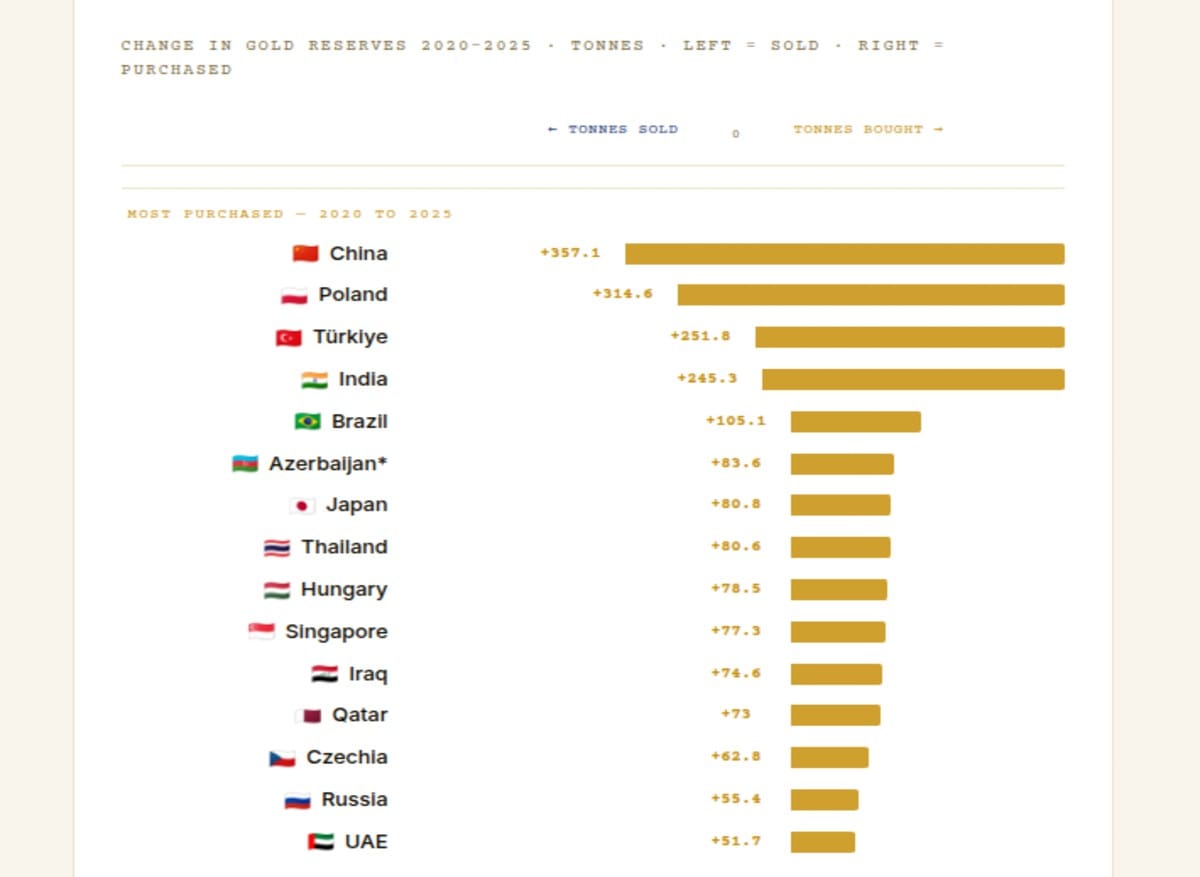
Change in Gold Reserves 2020–2025 · Tonnes · Left = Sold · Right = Purchased
Source: World Gold Council · *Azerbaijan gold held in State Oil Fund (SOFAZ) · Tonnes of gold added or removed from official reserves 2020–2025
← Tonnes Sold
0
Tonnes Bought →
+357t
China
Largest single-country purchase · De-dollarisation strategy
Largest single-country purchase · De-dollarisation strategy
+315t
Poland
NATO frontline state · Strategic reserve diversification
NATO frontline state · Strategic reserve diversification
−65t
Philippines
Largest seller · Liquidated during FX stress periods
Largest seller · Liquidated during FX stress periods
−0.1t
Switzerland
Smallest net change — disciplined reserve stability
Smallest net change — disciplined reserve stability
The De-Dollarisation Trade
The surge in central bank gold purchasing since 2020 is the most consequential shift in global reserve management in decades — and it is inseparable from the geopolitical rupture of that period. The Russian invasion of Ukraine in February 2022, and the subsequent freezing of approximately $300 billion in Russian sovereign dollar reserves held in Western financial institutions, sent an explicit signal to every central bank that held dollar reserves: the US dollar's status as a reserve currency came with a previously underappreciated political condition. A government deemed adversarial by Washington could find its reserve assets frozen, rendering them temporarily or permanently inaccessible. The rational response for any central bank that perceived even a small probability of future US sanctions exposure was to diversify reserves toward assets that could not be frozen — and gold, held in physical form within the country's own territory, is the only major reserve asset with this property.
China's 357-tonne net purchase over the 2020–2025 period is the largest among the buyers in this dataset but is widely believed to understate actual Chinese gold accumulation. China's central bank (the People's Bank of China) reports gold reserves on a schedule that many analysts believe is selective — disclosing purchases during periods of price weakness while not immediately reporting accumulation during price spikes that might itself be influenced by China's buying. The World Gold Council's figures represent officially declared reserve changes; the actual quantity of gold controlled by the Chinese state, including holdings in state-owned commercial banks and the sovereign wealth fund, is substantially higher and not fully disclosed. China's declared reserves of approximately 2,264 tonnes place it sixth globally — but its actual gold exposure is almost certainly higher than any official figure suggests.
The freezing of Russia's dollar reserves in 2022 was a watershed moment in reserve management history. It demonstrated that dollar reserves are not truly sovereign assets — they are claims on a financial system that can be rendered inaccessible by political decision. Every central bank in the world updated its risk models accordingly.
Poland and the Frontline Premium
Poland's 314.6-tonne net purchase is the second-largest in the dataset and the most strategically explicit. Poland's National Bank Governor Marek Belka announced in 2021 that the country intended to reach gold reserves of 100 tonnes; by 2024 Poland held over 400 tonnes — the largest gold reserve among Central and Eastern European NATO members. The explicit rationale was security: as a NATO member on the geographic frontline between the Alliance and Russia, Poland's central bank identified physical gold as a reserve asset that would retain value even in extreme scenarios — including scenarios in which financial infrastructure was disrupted or inaccessible. Poland's gold accumulation is a bet on resilience, not returns — an acknowledgment that the scenarios for which a country on the edge of Europe's most severe conflict in 80 years needs to prepare are scenarios in which conventional reserve management assumptions may not hold.
The Sellers: Liquidity Needs and Fiscal Pressure
The Philippines' 65.2-tonne net sale — the largest reduction in the dataset — reflects a fundamentally different reserve management challenge. The Philippines experienced significant currency stress in 2022–2023, when the peso weakened sharply against the dollar amid global interest rate increases and capital outflows from emerging markets. In currency defence operations, the Bangko Sentral ng Pilipinas sold dollars from its reserves to support the peso — and also liquidated gold holdings, which provide liquid reserves in foreign exchange terms but require a sale transaction to be deployed for intervention. The Philippines' gold sales illustrate the central trade-off in reserve management: gold preserves value and cannot be politically frozen, but it is operationally less liquid than dollar-denominated instruments when rapid deployment is needed for currency intervention.
Kazakhstan's 52.4-tonne reduction is more complex. Kazakhstan is a significant gold producer — the National Bank of Kazakhstan buys domestically mined gold as a standing policy, accumulating reserves through production rather than market purchases. The net reduction in the 2020–2025 period reflects a period of selling from previously accumulated reserves during fiscal stress, when oil revenue declined and the government required foreign exchange support. Kazakhstan's pattern — accumulate during commodity price booms, liquidate during busts — is a recurring cycle for resource-dependent economies whose reserve management is ultimately constrained by fiscal needs that override strategic reserve objectives.
What $3,300 Gold Changes
Gold's 265% price increase since 2020 has transformed the economics of central bank reserve management in ways that are still being absorbed. A tonne of gold purchased at $1,500/oz in 2020 is worth approximately $3,300/oz in 2025 — meaning early buyers have seen their holdings approximately double in dollar value without adding a single additional ounce. This creates a feedback dynamic: the countries that accumulated most aggressively before the price surge — China, Poland, India, Turkey — have generated substantial unrealised gains that strengthen their reserve positions, reduce the fiscal cost of the gold strategy, and validate the accumulation decision politically. Countries that have not accumulated — or that sold, like the Philippines and Kazakhstan — have missed the appreciation while simultaneously watching the strategic case for gold grow.
The open question is whether the current gold price level creates a natural ceiling for continued central bank accumulation. At $3,300/oz, a 100-tonne purchase costs approximately $10.6 billion — a significant allocation for most central banks. The IMF's reserve adequacy benchmarks do not currently include gold as a primary reserve metric, meaning central banks that wish to accumulate further gold must do so against the opportunity cost of not holding income-generating dollar or euro assets. For large buyers like China and India, whose reserve pools are large enough to absorb the opportunity cost, continued accumulation remains rational. For smaller economies with tighter reserve constraints, the price appreciation may moderate the pace of future buying even as the strategic case for gold has strengthened.
End of Brief · Prism
