
AIRLINES WITH THE MOST LEGROOM
Prism · Travel & Consumer Rights
Business Traveller · Condé Nast Traveler · Simple Flying
THE MOST
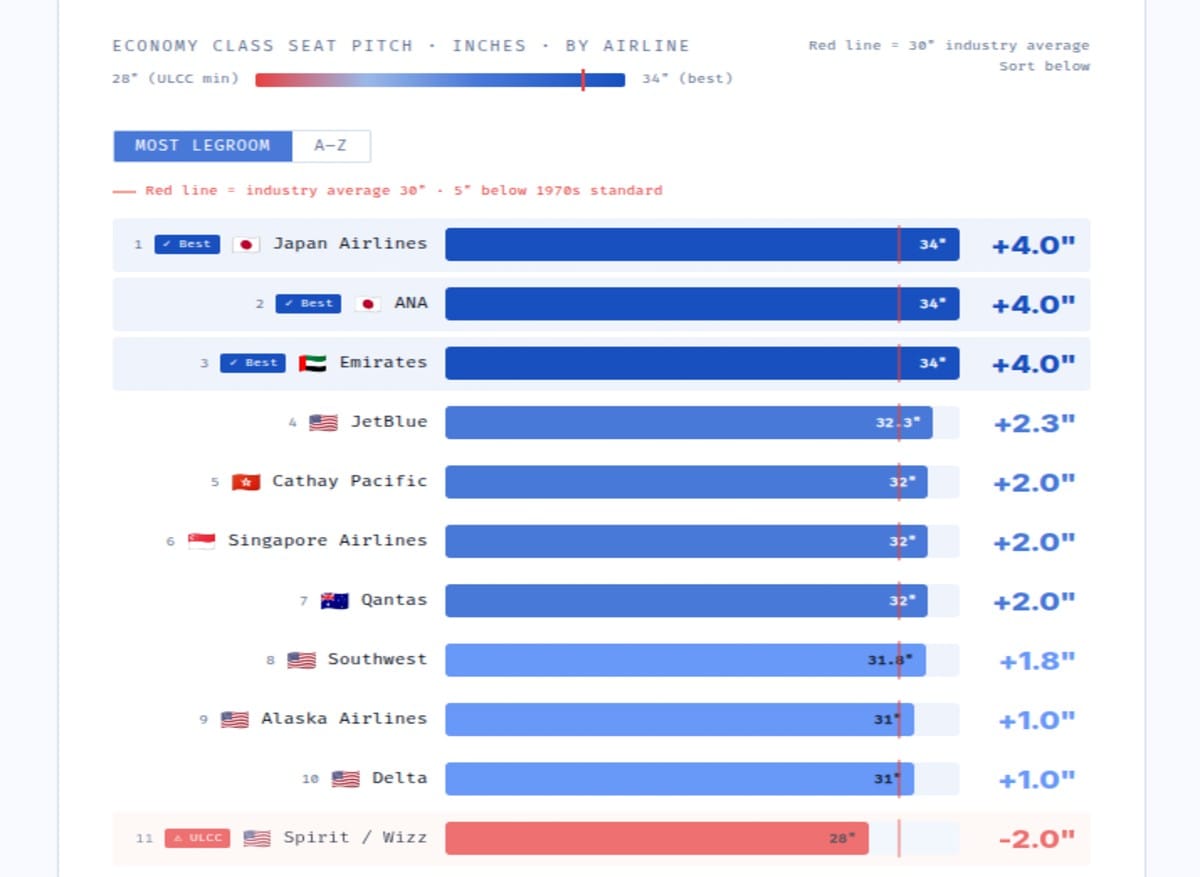
LEGROOM Over the past 50 years, the average economy seat pitch has shrunk from 35 to 30 inches. Japan Airlines and ANA offer 34 inches — still less than the average economy seat of 1975. Ultra-low-cost carriers like Spirit can go as low as 28 inches, fitting an extra row where a human spine used to be.
Metric: Economy class seat pitch in inches · Seat pitch = distance from same point on one seat to same point on the seat in front
Not the same as legroom: seat pitch minus seat back thickness (~4–5") = actual legroom
Sources: Business Traveller · Condé Nast Traveler · Simple Flying
Not the same as legroom: seat pitch minus seat back thickness (~4–5") = actual legroom
Sources: Business Traveller · Condé Nast Traveler · Simple Flying
📏 The shrinking cabin: Average economy seat pitch has declined from 35 inches in the 1970s to approximately 30 inches today — a loss of 5 inches per passenger over 50 years. Ultra-low-cost carriers like Spirit and Wizz Air can operate at 28 inches — 7 inches below the 1970s standard.
Economy Class Seat Pitch · Inches · By Airline
28" (ULCC min)
34" (best)
Red line = 30" industry average
Sort below
Sort below
Red line = industry average 30" · 5" below 1970s standard
⚠️ Ultra-low-cost carriers (Spirit, Wizz Air, Ryanair, Frontier): Seat pitch as low as 28" — effectively 23–24" of actual legroom once seat back thickness is subtracted. The average adult male requires approximately 30" of seat pitch for minimal comfort on short flights. On long-haul routes, sub-30" pitch is associated with increased risk of deep vein thrombosis (DVT).
Sources: Business Traveller · Condé Nast Traveler · Simple Flying · Seat pitch varies by aircraft type and seat row within airline
34"JAL / ANA / Emirates
Joint Best Economy
Joint Best Economy
28"ULCC Minimum
Spirit / Wizz Air
Spirit / Wizz Air
30"Industry Average
2025
2025
35"Average Economy
Pitch 1970s
Pitch 1970s
The 5-Inch Disappearance
The average economy class seat pitch — the distance from one point on a seat to the same point on the seat in front — has declined from approximately 35 inches in the 1970s to 30 inches today. This five-inch reduction, accumulated over fifty years, represents one of the most consistent examples of progressive degradation of a mass consumer experience in modern aviation. It is also a precise illustration of how competitive market dynamics can produce outcomes that are bad for everyone except the companies generating short-term revenue gains from them.
Seat pitch is not exactly the same as legroom. Actual legroom is seat pitch minus the thickness of the seat back — typically 4–5 inches — meaning a 30-inch seat pitch delivers approximately 25–26 inches of actual legroom from knee to the seat back in front. At 30 inches of pitch, a person of average height (5'9" in the United States) has their knees touching or nearly touching the seat in front when upright. Any recline by the passenger in front — which is made possible by the same seat mechanism — immediately creates physical pressure on the passenger behind. The recline conflict that has become a recurring feature of economy cabin behaviour is not a social problem. It is an engineering consequence of shrinking seat pitch to the point where the recline action of one passenger transfers directly to the body of another.
The recline conflict is not a manners problem. It is a physics problem — an inevitable consequence of fitting an extra row into every cabin by removing the space that would have made recline socially viable.
Japan Airlines and ANA at 34": A Policy, Not an Accident
Japan Airlines and ANA's consistent offering of 34-inch economy seat pitch — tied with Emirates as the best in the industry — is not a happy accident of aircraft configuration. It is a deliberate policy maintained by airlines whose primary competitive strategy in long-haul premium economy is centred on the experience quality of their cabins across all classes. Japanese aviation culture, with its emphasis on service quality and passenger comfort as brand differentiators, has resisted the pure revenue-per-square-foot optimisation logic that has driven American and European legacy carriers to progressively reduce pitch.
At 34 inches, JAL and ANA passengers have approximately 29–30 inches of actual legroom — still less than the average economy seat of 1975, but meaningfully more comfortable than the 25–26 inches delivered by the industry average. The difference between 34 and 30 inches of seat pitch is, for many travellers, the difference between an 11-hour transpacific flight that is uncomfortable and one that causes lasting lower back pain. The fact that JAL and ANA have maintained this standard while remaining commercially viable airlines directly refutes the argument that 30-inch seat pitch is an economic necessity.
Emirates at 34": Premium Brand Strategy in Economy
Emirates' 34-inch economy seat pitch is part of a broader cabin strategy that uses economy class quality as a marketing tool for premium brand perception. Emirates' economy cabin — with its generous pitch, above-average seat width, and one of the industry's better in-flight entertainment systems — creates a brand experience that differentiates it from competitors in a market where price comparison is easy but quality comparison is harder. A traveller who flies Emirates economy and finds it substantially more comfortable than competing airlines is more likely to consider Emirates for premium economy or business class on their next trip — making the economy quality investment partly a customer acquisition cost for higher-yield passengers.
JetBlue at 32.3": The American Outlier
JetBlue's 32.3-inch average economy pitch makes it the most generous American carrier in the dataset, and the airline has historically positioned its above-average economy comfort as a core brand differentiator. JetBlue introduced the "Even More Space" product with additional legroom rows at premium prices, but its baseline economy pitch remains above the American industry average. This positioning has been under pressure as JetBlue has faced profitability challenges — the temptation to add rows by reducing pitch is ever-present when revenue per flight is under strain.
The contrast between JetBlue at 32.3 inches and Spirit Airlines at 28 inches — both American carriers, theoretically competing for some of the same passengers — illustrates the bifurcation of the American domestic aviation market into carriers that compete primarily on price by stripping all comfort features and carriers that compete partly on experience. This bifurcation has accelerated significantly since the COVID-era travel demand recovery, which showed that American travellers would accept almost any cabin conditions in exchange for lower fares on short domestic routes.
The ULCC Problem: 28 Inches and the Body
Ultra-low-cost carriers like Spirit, Frontier, Ryanair, and Wizz Air operate at seat pitches as low as 28 inches. At this pitch, the actual legroom is approximately 23–24 inches — roughly two feet from knee to seat back. This is below the threshold considered minimum for adult comfort on any flight longer than one hour, and on flights longer than three hours, it creates physical conditions associated with increased risk of deep vein thrombosis, the potentially fatal blood clotting condition that develops when blood pools in legs forced into a contracted, immobile position for extended periods.
The economics that produce 28-inch seat pitch are straightforward: every inch of seat pitch removed allows the airline to add approximately one row of seats per aircraft. A row of 180 seats on a narrow-body aircraft flying ten routes per day generates significant incremental revenue. At scale across a fleet of hundreds of aircraft, the revenue from shrinking seat pitch from 30 to 28 inches runs into hundreds of millions of dollars per year. The regulatory question is whether airlines should be permitted to sell a product that creates material health risks for passengers who cannot reasonably assess those risks at the point of purchase. The United States Congress has debated minimum seat size requirements for over a decade without passing legislation, primarily due to airline industry lobbying that frames passenger comfort regulations as anti-competitive government interference in pricing markets.
India's Aviation Boom: Setting Standards Now
India's domestic aviation sector has expanded dramatically, with IndiGo, Air India, and Akasa Air collectively operating hundreds of aircraft on hundreds of routes. India is now one of the world's fastest-growing aviation markets, and the seat pitch standards that Indian carriers adopt in this expansion phase will shape the cabin experience of hundreds of millions of Indian travellers for decades. IndiGo — India's dominant carrier with over 60% domestic market share — operates at seat pitches in the 28–29 inch range on many of its aircraft configurations, placing it in the ULCC territory by the standards of the data presented here.
The regulator — India's Directorate General of Civil Aviation (DGCA) — has historically not specified minimum seat pitch requirements, leaving configuration decisions to airlines. The result is a market where fare competition dominates and cabin density is continuously optimised for revenue yield. As Air India's Tata Group-backed transformation includes fleet upgrades and positioning for the premium international market, there may be competitive pressure on IndiGo to differentiate on economy comfort as the Indian middle class becomes more travelled and more discerning. But that competitive dynamic requires time and affluence to develop — for now, 28 to 29 inches is where most Indian domestic economy passengers sit.
End of Brief · Prism ✈️