6 Trends Reshaping U.S. Property Insurance
Prism · Property Insurance & Climate Risk
6 Trends Reshaping
U.S. Property Insurance Material inflation, expanding climate hazard zones, aging buildings, population migration into risk corridors, and the emergence of new technology-linked risks are converging to produce the most challenging property insurance pricing environment in a generation.
U.S. Property Insurance Material inflation, expanding climate hazard zones, aging buildings, population migration into risk corridors, and the emergence of new technology-linked risks are converging to produce the most challenging property insurance pricing environment in a generation.
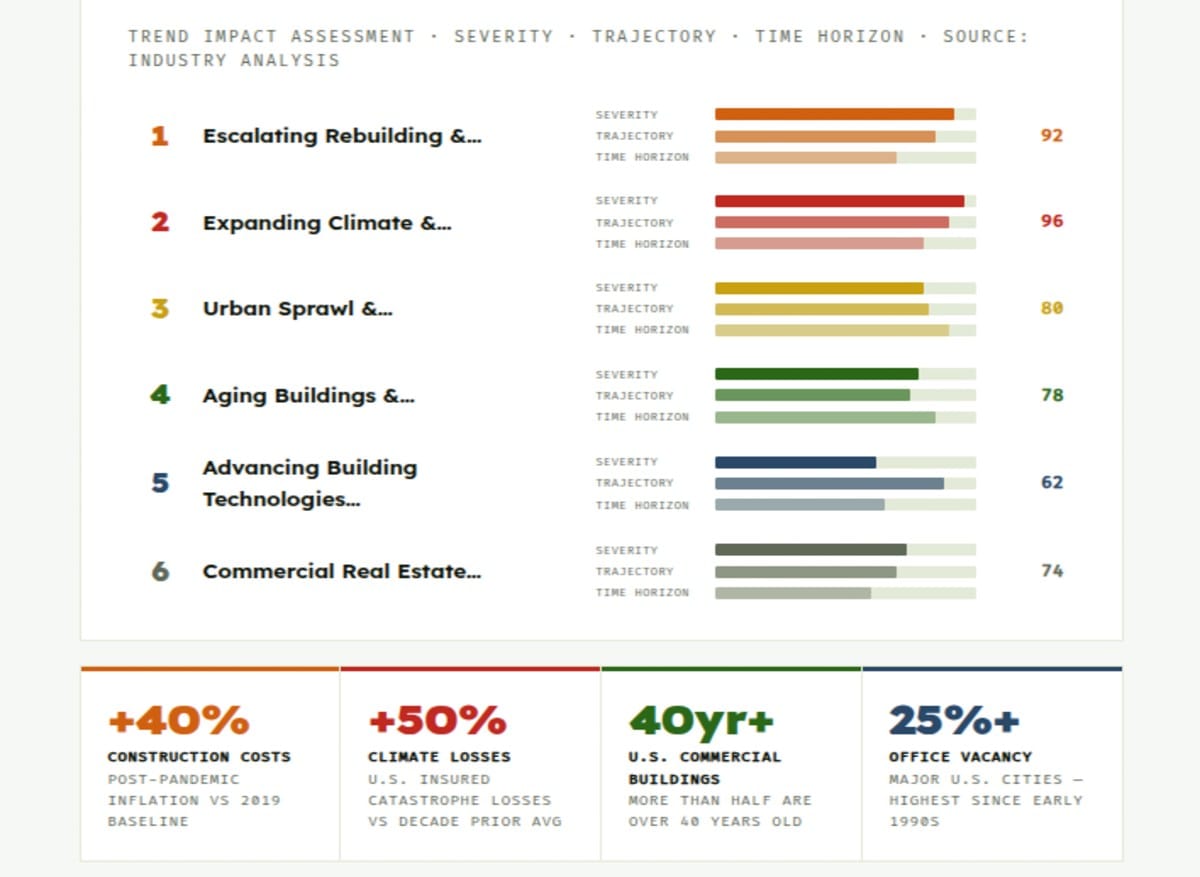
Trend Impact Assessment · Severity · Trajectory · Time Horizon · Source: Industry analysis
+40%
Construction costs
Post-pandemic inflation vs 2019 baseline
Post-pandemic inflation vs 2019 baseline
+50%
Climate losses
U.S. insured catastrophe losses vs decade prior avg
U.S. insured catastrophe losses vs decade prior avg
40yr+
U.S. commercial buildings
More than half are over 40 years old
More than half are over 40 years old
25%+
Office vacancy
Major U.S. cities — highest since early 1990s
Major U.S. cities — highest since early 1990s
Construction Cost Inflation: The Rebuild Gap
The most immediate driver of property insurance repricing is the inflation of reconstruction costs relative to the insured values that policies were written at. Between 2019 and 2024, construction materials costs increased by approximately 40% — driven by pandemic supply chain disruption, labour market tightening in skilled trades, and ongoing fragility in materials supply chains for lumber, steel, concrete, and electrical components. The consequence is that a property insured for $1 million in 2019 now costs approximately $1.4 million to rebuild — and policies that were written without automatic replacement cost adjustment have significant coverage gaps that neither policyholders nor their insurers have fully priced.
The skilled labour shortage is the most persistent component of the cost inflation. The construction industry's workforce is aging — the average age of a construction worker in the US is 43 — and the apprenticeship and training pipeline has not kept pace with demand. Electricians, plumbers, HVAC technicians, and structural specialists are in shortage in every major market, with waiting times for post-loss repair contractors extending to months in high-demand periods after catastrophe events. The cost of a repair that takes six months is not just the materials — it is the carrying cost of the property, the business interruption, and the contractor time premium that acute demand creates. Loss adjustment reserve estimates made immediately after a catastrophe event have systematically understated final costs for this reason.
The insured value on a commercial property policy written in 2019 may cover 70 cents of every dollar it costs to rebuild in 2026. The rebuild gap — the difference between insured value and actual replacement cost — is one of the most underappreciated systemic risks in the U.S. property insurance market.
Climate Exposure: Moving Catastrophe Maps
The second trend is the most consequential for long-term insurability: the expansion of natural hazard exposure beyond historical zones. U.S. property insurance has been priced largely on the basis of historical catastrophe models — statistical distributions of hurricane landfall, wildfire spread, flood extent, and convective storm intensity derived from 30–50 years of historical data. Climate change is systematically invalidating these historical distributions, particularly in three hazard categories: wildfire (expanding dramatically in geographic extent and intensity beyond the traditional California-focused model), inland flooding (moving away from mapped FEMA 100-year floodplains toward locations that have never historically flooded at significant rates), and severe convective storms (hailstorms, tornadoes, and derechos in regions that have not historically been modelled as primary catastrophe zones).
The insurance industry's response has been predictable: retrenchment from the most affected markets. Multiple major carriers have non-renewed or significantly restricted new business in California, Florida, Louisiana, and Colorado — the states with the most acute climate-related loss experience. The resulting coverage gaps have forced homeowners into state-backed last-resort plans (California FAIR Plan, Florida Citizens) that are capitalised at levels that would not survive a major correlated event. The concentration of risk in under-capitalised last-resort pools is itself a systemic risk that has not been fully priced by state and federal regulatory frameworks.
Urban Sprawl Into Risk Corridors
The third trend compounds the second: the systematic migration of US population into the geographic zones where climate hazard is increasing. The wildland-urban interface — the boundary between developed land and wildland vegetation — expanded substantially in the 2010s as population growth in Arizona, Nevada, Texas, Florida, and the mountain West pushed residential development into fire-prone terrain. Coastal development in Florida, the Carolinas, and the Gulf Coast has continued despite repeated catastrophic hurricane seasons. The combination of increasing hazard intensity and increasing asset exposure in hazard zones is multiplicative, not additive: the expected insured loss from a given hurricane or wildfire event is rising both because individual events are becoming more severe and because the number and value of assets in the event's footprint is growing.
Aging Buildings and Deferred Maintenance
More than half of US commercial properties are over 40 years old — and were built to building codes that did not anticipate current climate conditions, did not incorporate modern seismic standards in many locations, and did not account for the electrical, HVAC, and plumbing demands of modern building operations. The combination of aging systems and decades of deferred maintenance — accelerated by the pandemic era's disruption of property management and capital expenditure programmes — has created a commercial building stock that is systematically more vulnerable to fire, water, and structural loss than the insured values and underwriting assumptions suggest. This is particularly acute in the commercial real estate sector, where the combination of rising capital costs, declining asset values, and ownership stress has dramatically reduced maintenance investment across the portfolio.
The New Technology Risk
The final trend is the one that most directly generates new and undermodelled loss exposure: the rapid adoption of rooftop solar panels, lithium-ion battery storage systems, and advanced electrical installations in both commercial and residential properties. These systems represent significant improvements in energy efficiency and resilience — but they also introduce new ignition pathways that the property insurance market does not yet have sufficient loss history to model with confidence. Lithium-ion battery fires are characteristically difficult to extinguish, prone to thermal runaway, and capable of producing total structural losses in properties that might otherwise have survived a more conventional fire event. The insurance industry is in the early stages of understanding what decades of widespread residential and commercial battery storage adoption will mean for fire loss frequency and severity — a period of uncertainty that is itself a pricing risk that conservative underwriters will price into premiums.
End of Brief · Prism
