5,000 Years of Wages
Prism · Labour History & Economics
5,000 Years
of Wages From Mesopotamian beer rations to earned-wage access apps — five millennia of how humanity has compensated work, when it has paid, and which forces have shifted the balance between employer and worker.
of Wages From Mesopotamian beer rations to earned-wage access apps — five millennia of how humanity has compensated work, when it has paid, and which forces have shifted the balance between employer and worker.
All Eras
Antiquity
Middle Ages
Early Modern
Modern Era
Digital Age
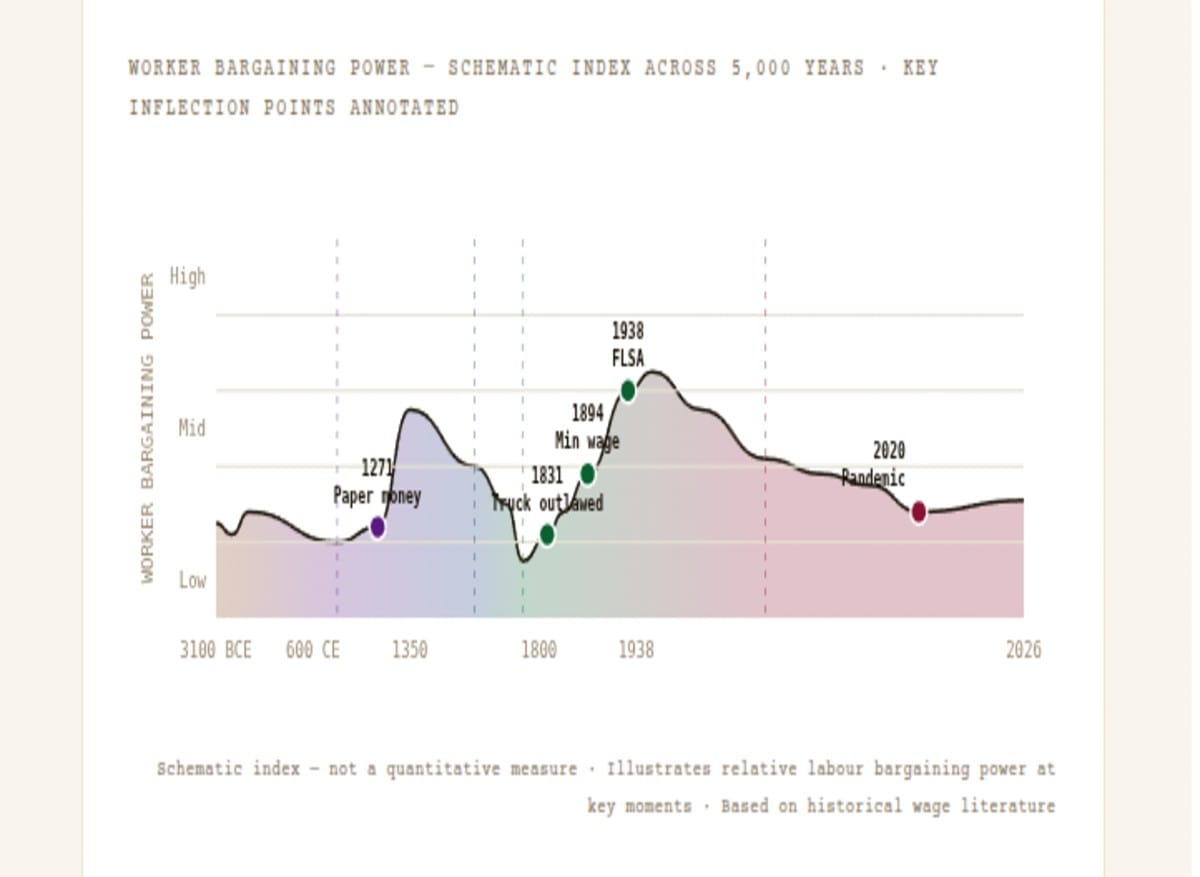
Worker Bargaining Power — Schematic Index Across 5,000 Years · Key Inflection Points Annotated
Schematic index — not a quantitative measure · Illustrates relative labour bargaining power at key moments · Based on historical wage literature
Beer, Grain, and the First Labour Markets
The earliest records of wage payment are also records of the earliest labour markets — and they are surprisingly sophisticated. The Mesopotamian clay tablet of approximately 3100 BCE that recorded daily beer rations for labourers was not an informal arrangement but a systematic accounting of worker compensation in the primary caloric currency of the ancient world. Beer and grain were wages because they were the things workers needed to live: liquid calories, stable storage value, and universal acceptability within the community. The Babylonian Code of Hammurabi of approximately 1750 BCE went further, codifying specific wage rates for specific occupations — a carpenter earned differently from a mason, who earned differently from a farm labourer. The Hammurabi code is the world's first minimum wage law in everything but name: it fixed floors below which certain occupations could not be paid, enforceable by the state.
The introduction of the Lydian Stater around 600 BCE — the first state-issued standardised coin — transformed wages from in-kind arrangements into monetary ones. The practical significance was profound: a coin of known value, issued by a recognised authority, could be saved, transferred, and spent across a wider geographic and social range than grain or beer. The monetisation of wages is not merely a technical change; it is the transition from a wage system embedded in specific social relationships (the master who provides grain) to one that is, in principle, transferable and anonymous. The coin is the precondition for labour markets in the modern sense — workers who can sell their labour to the highest bidder rather than to the lord or employer who controls their food supply.
The Black Death of 1346–1353 killed roughly half of Europe's population and produced the largest single wage increase in European history. Nothing illustrates the mechanics of labour markets more starkly: when workers became scarce, their bargaining power surged — not because of any law, union, or political movement, but because supply fell and demand remained.
The Black Death and the Price of Labour
The Black Death of 1346–1353 is one of the most consequential economic events in human history — and its wage effects were immediate, dramatic, and deeply revealing. When the plague killed approximately half of Europe's population, it did not reduce demand for labour proportionally: harvests still needed to be brought in, buildings constructed, goods manufactured. The sudden scarcity of workers in the face of approximately unchanged demand produced the largest wage increase in European history in the generation following the plague. Real wages in England roughly doubled in the 40 years after the Black Death — a compression of gains that would have taken a century or more to accumulate under normal conditions.
The ruling class recognised the dynamic immediately and attempted to legislate against it. The English Statute of Labourers of 1351 — passed while the plague was still active — attempted to freeze wages at pre-plague levels and bind workers to their previous employers. It failed: the underlying supply-and-demand reality was too powerful for statute to override. The post-plague wage surge is the clearest natural experiment in labour economics history, demonstrating that wages respond to labour market conditions independently of legal frameworks, moral arguments, or cultural norms. What changed wages was not the workers' argument that they deserved more — it was that there were fewer of them.
The Industrial Revolution's Paradox
The Industrial Revolution of the late 18th and early 19th centuries presents a paradox that economic historians continue to debate: a period of extraordinary productive growth that, in its early decades, produced no improvement in the living standards of the workers who generated it. The factory system reorganised labour into regular, timed, standardised shifts — William Bundy's timeclock of 1888 was the culmination of a decades-long project to make labour measurable, predictable, and manageable. The regular weekly pay packet replaced the irregular, in-kind, or seasonal payments of earlier eras. But the terms of this new arrangement were set by factory owners who controlled both the means of production and, through the truck system, the means of consumption: company scrip, redeemable only at company stores, returned wages to in-kind payment by a different mechanism. The British Parliament's outlawing of truck payment in 1831 was recognition that the formal monetisation of wages had been systematically undermined by employers who could not legally withhold wages but could effectively recover them through controlled retail.
The 19th century's labour legislation — the Ten Hours Act of 1847, New Zealand's minimum wage of 1894, the gradual expansion of these protections across the industrial world — represents a political correction to the power imbalance that the factory system had created. When workers could not individually negotiate the terms of their employment — when the alternative to accepting any offered wage was destitution — collective action through legislation became the mechanism by which the terms of the labour bargain were rebalanced. Every major labour protection of the 19th and early 20th centuries was a political response to a market failure: the inability of individual workers to bargain on equal terms with employers who controlled access to the means of subsistence.
The Architecture of Modern Pay
The mid-20th century saw the construction of the institutional architecture of modern payroll: regular biweekly payment cycles, mandatory tax withholding (introduced in the US in 1943 as a wartime financing measure and never removed), direct deposit through the Automated Clearing House system (launched in California in 1972 and extended nationally), and the automation of payroll processing (ADP's batch payroll innovation of 1957). The biweekly pay cycle that most American workers experience today is not a natural feature of labour markets — it is a legacy of mid-20th-century administrative technology that determined payroll processing frequency based on the capacity of batch computing systems. Workers are paid on cycles that were optimal for IBM mainframes in the 1960s, not for the financial needs of 21st-century workers.
The significance of the pay cycle is not merely administrative. A worker who earns $50,000 annually but is paid biweekly is, at any given moment, owed between zero and two weeks of wages that they have earned but not yet received — a float of up to approximately $1,900 that sits with the employer rather than the worker. For a worker with no savings buffer, the gap between when wages are earned and when they are paid creates a structural vulnerability: the unexpected expense that falls between paydays — a medical bill, a car repair, a utility disconnection notice — must be covered by credit at rates that may well exceed payday loan levels. The earned wage access innovation of 2013 is not a technological novelty; it is a correction to a 60-year-old administrative artifact that has been extracting value from workers who can least afford to provide their employers with a free short-term loan.
What Five Thousand Years Show
The arc of 5,000 years of wage history does not trace a steady progress toward worker welfare. It traces a more complicated story: of periodic crises that disrupted established power relationships and created windows of worker gain (the Black Death, the Industrial Revolution's legislative corrections, the post-WWII labour compact), interspersed with periods of re-consolidation in which the terms of the labour bargain shifted back toward employers. The mechanisms have changed — from royal decree to statute to collective bargaining to labour law — but the underlying dynamic has not: wages are the price of labour, and that price is set by the relative bargaining power of workers and employers, which is itself determined by labour market conditions, institutional arrangements, and political choices. The recurring lesson is that wages do not improve automatically with productivity or economic growth; they improve when workers have leverage, and they stagnate or fall when they do not.
The 2026 entry point in the timeline — the cost-of-living crisis in which 46% of Americans report the worst financial conditions of their lives — sits in a period of high nominal wages but compressed real wages, a labour market that has tightened and loosened, and a technological transition (AI-driven automation) whose wage effects are still being determined. History suggests the outcome depends less on the technology itself than on the institutional and political choices that determine how its productivity gains are distributed. Every era has had the technology of its time; the question in every era has been the same — who keeps the surplus that technology creates? That question has never been answered by markets alone.
End of Brief · Prism
