195 COUNTRIES. 6 CONTINENTS. ONE PLANET.
Prism · Geography & World Order
World Population Review · 2025
6 CONTINENTS.
ONE PLANET. Africa has 54 countries. Asia has 49. Europe has 43. Yet Asia holds 60% of humanity, Africa holds the fastest-growing populations, and Oceania's 14 nations include some of the world's smallest and most climate-vulnerable states. The map of countries is a map of history as much as geography.
Total: 195 countries · All 193 UN member states + Vatican City and Palestine (UN observer states)
Population data: World Population Review 2025 · Continental classifications may vary by source
Antarctica has no countries and is excluded · Russia counted in Europe (HQ) · Turkey counted in Asia
Population data: World Population Review 2025 · Continental classifications may vary by source
Antarctica has no countries and is excluded · Russia counted in Europe (HQ) · Turkey counted in Asia
Countries by Continent · Population · 2025
Click a continent to explore its countries
Sort by name or population
Sort by name or population
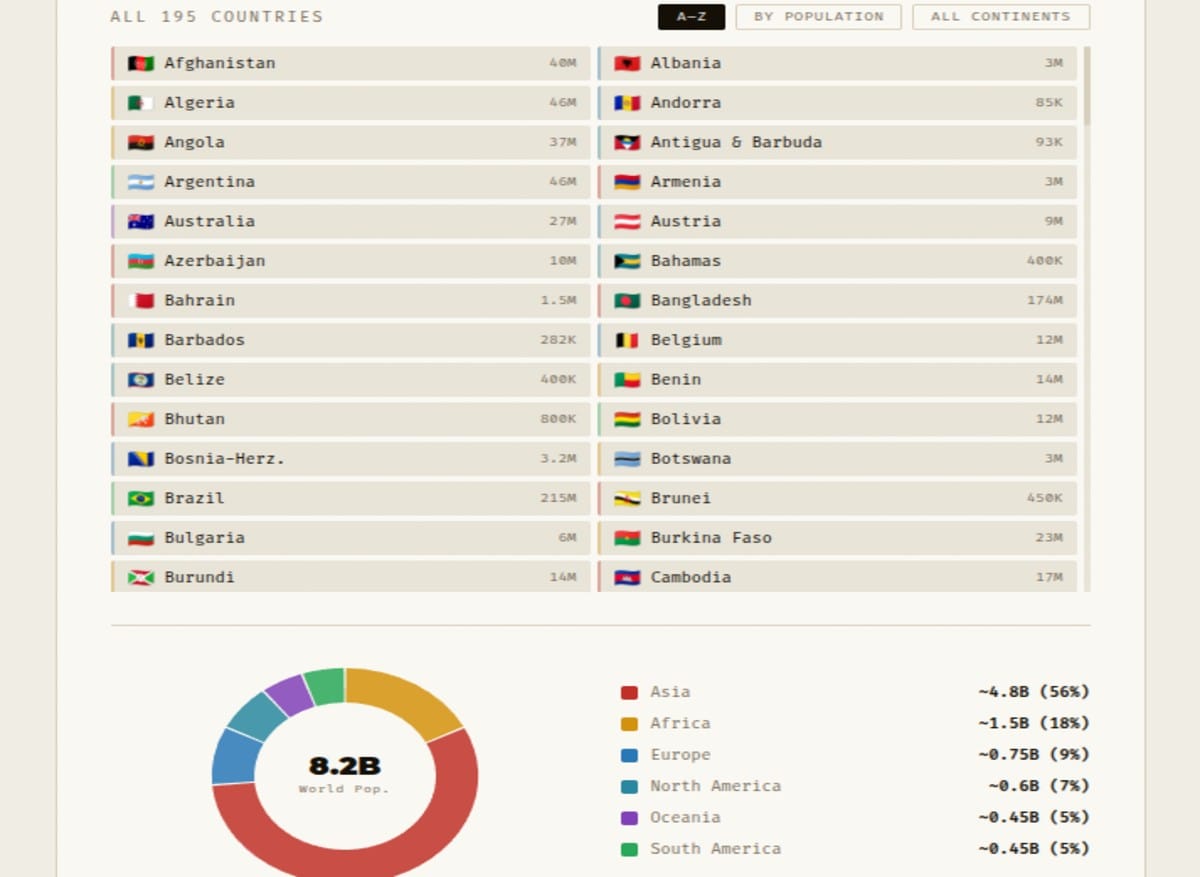
All 195 Countries
8.2B
World Pop.
Source: World Population Review 2025 · Includes all 193 UN member states + Vatican City and Palestine
54Africa
Most Countries
Most Countries
4.8BAsia
Population
Population
43Europe
Countries
Countries
14Oceania
Countries
Countries
Why Africa Has 54 Countries
Africa's 54 sovereign states — the most of any continent — is not a natural geographic outcome. It is a direct product of European colonial cartography. The Berlin Conference of 1884-1885, where European powers divided Africa among themselves in a process Africans had no part in, drew borders that cut across ethnic, linguistic, and ecological boundaries with no regard for pre-existing political structures. When decolonisation swept Africa between the late 1950s and the 1970s, the new nations that emerged largely inherited these arbitrary colonial boundaries — the Organisation of African Unity (predecessor to the African Union) enshrined the principle of uti possidetis, preserving colonial borders to prevent the fragmentation that might arise from redrawing them.
The result is a continent of 54 countries whose borders correspond poorly to cultural or ecological realities, and whose average country size is approximately 560,000 square kilometres — comparable to France — but whose internal diversity (ethnic, linguistic, religious) is often extraordinarily high. Nigeria alone has over 500 ethnic groups and 525 languages. The DRC covers 2.3 million square kilometres and encompasses some of the most linguistically diverse territory on Earth. Africa's 54-country map is simultaneously the most politically fragmented in the world and the product of a process of boundary-drawing that represented the most concentrated external imposition of political geography in history.
Africa has 54 countries. Asia has 49. But Asia holds 60% of humanity. Europe has 43 countries but only 10% of the world's people. The map of countries and the map of people are very different maps.
Asia's 49: Diversity at Planetary Scale
Asia's 49 countries hold approximately 4.8 billion people — roughly 60% of all humanity — across a geographic range that spans the world's highest mountains, largest deserts, most productive agricultural plains, and most dynamic economic corridors. The continent contains the world's two most populous nations (China and India, together accounting for nearly 3 billion people), the world's largest country by area (Russia, if one counts its Asian portion), and some of the world's smallest and most densely packed city-states (Singapore at 5.9 million in 733 square kilometres).
Asia's internal diversity defies any simple characterisation. The continent includes the world's most advanced technology economies (Japan, South Korea, Taiwan, Singapore), the world's largest democracy (India), the world's largest authoritarian state (China), the world's most active conflict zones (parts of the Middle East and South Asia), and the world's fastest-growing emerging markets (Vietnam, Bangladesh, Indonesia). The concept of "Asia" as a coherent unit is itself a European cartographic convention — the populations of Japan and Pakistan or Iran and the Philippines share no more cultural, linguistic, or political commonality than Europeans and Latin Americans do.
Europe's 43: The Continent of Fragmentation
Europe's 43 countries in a relatively compact geographic area — comparable in size to Australia — reflects centuries of political fragmentation driven by ethnic nationalism, religious conflict, and the collapse of multi-ethnic empires. The Habsburg, Ottoman, and Soviet empires between them once governed most of the continent; their successive collapses produced waves of new nation-states: the post-World War I nationalisms (Poland, Czechoslovakia, Yugoslavia, the Baltic states), the post-World War II reorganisation, and the post-1991 dissolution of the Soviet Union and Yugoslavia that alone added 22 new states to the map.
Europe's country fragmentation coexists with the European Union's political integration project — 27 of Europe's 43 countries are EU members, participating in a shared legal, economic, and regulatory framework that partially transcends national sovereignty. The tension between this integration impulse and the continued salience of national identity (visible in Brexit, Hungarian nationalism, and Italian political volatility) defines contemporary European politics. Europe has the most sophisticated experiment in post-national governance on Earth, and it remains genuinely contested.
Oceania's 14: The Smallest and Most Vulnerable
Oceania's 14 countries span an extraordinary range: Australia at 7.7 million square kilometres and 26 million people at one extreme, and Tuvalu at 26 square kilometres and 11,500 people at the other. The Pacific island nations of Oceania are, in many respects, the most climate-vulnerable states on Earth. Kiribati, Tuvalu, the Marshall Islands, and parts of the Maldives (technically in Asia, Indian Ocean) face the existential prospect of complete territorial inundation from sea level rise as climate change progresses. Kiribati's government has already purchased land in Fiji as a contingency relocation plan — a step with no precedent in modern international relations.
The Pacific island states also represent a contested geopolitical space. China has significantly increased its diplomatic and economic engagement with Pacific nations since 2019, signing security agreements with the Solomon Islands and offering financial assistance across the region in ways that have alarmed Australia, New Zealand, and the United States. The 14 countries of Oceania — many with populations smaller than a mid-sized Indian city — find themselves at the centre of a strategic competition between major powers who have geopolitical interests in their maritime exclusive economic zones (EEZs), which collectively cover an enormous portion of the Pacific Ocean.
North America's 23 and South America's 12
North America's 23 countries — including the Caribbean island states — reflect the continent's particular colonial history, with Spanish, British, French, and Dutch colonial legacies producing a patchwork of small island nations alongside the large continental states of the United States, Canada, and Mexico. South America's 12 countries, by contrast, are relatively large-format states that emerged from a dominant Spanish colonial experience (with Brazil as the Portuguese exception).
South America's 12 countries is the smallest number of any inhabited continent, but the continent contains some extraordinary national-scale statistics: Brazil at 215 million people is the world's seventh-largest economy and the largest country in the Southern Hemisphere; Colombia's 53 million people live in a state that has transitioned from being one of the world's most violent countries to one of Latin America's most dynamic economies within a single generation.
The Number That Keeps Changing
195 countries is the current count, but it is not a stable number — it has changed significantly over the past century and will likely change again. In 1945, the United Nations was founded with 51 member states. Today it has 193. The additions reflect decolonisation waves (1950s-1970s), the dissolution of the Soviet Union and Yugoslavia (1991-1992), and continued emergence of new states (South Sudan in 2011 is the most recent universally recognised nation). Disputed territories — Western Sahara, Kosovo, Palestine, Taiwan, South Ossetia — represent potential future additions if their status is resolved.
The concept of the nation-state itself — the territorial unit of international order since the Peace of Westphalia in 1648 — is being simultaneously challenged from above (by supranational institutions like the EU, UN agencies, the International Criminal Court) and from below (by subnational movements for autonomy or independence in Scotland, Catalonia, Balochistan, Tamil Nadu's historical separatist movements, and dozens of other contexts). Whether the next century sees the number 195 rise toward 250 as further fragmentation occurs, or fall toward 150 as regional integration deepens, may be the most consequential geopolitical question that rarely gets asked. For India — a federal republic whose unity is managed, not assumed — the global story of how borders are made and unmade is not merely academic.
End of Brief · Prism
